Security Audit Skill Review (2026): AI-Driven Vulnerability
⚡ Executive Summary
Security Audit Skill review: Discover how this agentic framework reduces AI hallucinations to find verified vulnerabilities in your code. Read our full verdict.
As software development moves toward agentic workflows, the way we secure code must change. Static Analysis Security Testing (SAST) and Dynamic Analysis (DAST) are the old pillars of security. However, they often produce too many false positives and lack context. Security Audit Skill is a specialized coding-agent framework designed to bridge the gap between basic automated scanning and manual penetration testing.
Disclaimer: This review is based on publicly available information, including official documentation, the public GitHub repository, and pricing pages; it is not based on a laboratory benchmark.
What is Security Audit Skill? #
Security Audit Skill Explained #
Security Audit Skill is an open-source framework developed by Cloudflare that enables AI agents to perform deep security reviews. Instead of simple pattern matching, it uses a multi-step loop of reconnaissance, hypothesis, and verification to find and prove the existence of software vulnerabilities in a machine-readable format.
In-Depth Feature Breakdown & Technical Substance #
Security Audit Skill moves away from "one-shot" analysis. It uses a phased execution model that mimics how a human researcher thinks.
1. The Multi-Phase Audit Workflow #
The tool does not just scan a file for bugs. It follows a rigorous cycle:
- Reconnaissance: The agent maps the attack surface. It identifies entry points, data flows, and trust boundaries.
- Hypothesis Generation: The agent identifies a suspicious pattern. For example, it might find an unsanitized input in a SQL query and hypothesize a SQL injection risk.
- Verification: The agent must prove the flaw exists. It does this by suggesting a proof-of-concept (PoC) or tracing a specific execution path that leads to a crash or leak.
Practical Example: If a developer adds a new API endpoint, the agent won't just flag "missing input validation." It will hypothesize that a specific header can be spoofed to bypass admin checks. It then verifies if the backend logic actually allows that spoofed header to grant unauthorized access.
2. Verified, Machine-Readable Findings #
A major problem with AI is "hallucination." Many AI tools flag "best practice" tips as "critical bugs." This framework solves that by requiring evidence. The agent cannot report a bug unless it can verify it.
The output is provided in structured data (like JSON). This allows teams to pipe results directly into Jira or GitHub Issues. This structured approach is vital for teams integrating agentic frameworks—similar to those discussed in our Agent Native Review (2026): Best Framework for Agentic Apps?—into their CI/CD pipelines.
3. Integration into Production Workflows #
This tool is built for the "Production Developer." It is modular and can live in pre-commit hooks or as a mandatory check in Pull Requests (PRs). For teams using high-performance runtimes—such as those exploring the speeds in our JS Runtime Review: Is Bun the Fastest Choice for 2026?—this ensures that deployment speed does not create security gaps.
Technical Implementation Guide #
Since this is a repository-based tool for agents, setup is about integration rather than a simple "install" click.
Configuration Steps #
- Clone the Source: Get the latest version from the official GitHub repository.
- Agent Integration: Connect the skill to an AI agent framework. The agent must support tool-calling and have read/write access to the file system.
- Scope Definition: Define the target directory. Limit the scope to specific modules to save on token costs.
- Execution: Trigger the reconnaissance phase. Ensure the agent has a sandbox environment if you want it to attempt active verification.
- Output Parsing: Use a script to parse the JSON findings into your team's tracking tool.
Edge Cases to Consider #
- Large Monoliths: In very large codebases, the agent may lose context. It is better to run the tool on a per-module basis.
- Obfuscated Code: If the code is minified or obfuscated, the reconnaissance phase will likely fail.
- Complex Dependencies: The tool is best at finding logic flaws in the primary code, not deep vulnerabilities hidden in third-party binary blobs.
Objective Pros & Cons Matrix #
| Pros | Cons |
|---|---|
| Low Hallucination Rate: The verification step ensures findings are based on evidence. | High Token Cost: The iterative loop uses far more API credits than a single scan. |
| Open Source: No vendor lock-in; you can customize the logic for your own standards. | Steep Setup Curve: It is not "plug-and-play" and requires an existing agent infrastructure. |
| Structured Output: Machine-readable logs make automation into Jira or GitHub easy. | LLM Dependency: The tool is only as smart as the model (e.g., GPT-4o or Claude 3.5) powering it. |
| Expert Methodology: It follows a logical research path rather than simple regex patterns. | Risk of False Negatives: If the agent doesn't hypothesize a specific path, it won't find the bug. |
Honest Limitations & Trade-offs #
While powerful, this tool is not a silver bullet. Users must accept four primary trade-offs:
- Inference Latency: Because the tool loops through hypothesis and verification, a single audit can take minutes or hours. It is not suitable for real-time "as-you-type" linting.
- Infrastructure Overhead: You cannot simply download an .exe file. You must manage the LLM API keys, the agent framework, and the environment permissions.
- The "Blind Spot" Problem: The tool relies on the LLM's ability to "imagine" an attack. If the model has not seen a specific type of zero-day vulnerability in its training data, it will likely miss it.
- Token Burn: For a medium-sized project, the cost of the multi-phase loop can be 10x to 50x higher than a standard AI code review.
Comparison: Security Audit Skill vs. Alternatives #
| Feature | Security Audit Skill | Traditional SAST | Generic AI Prompting |
|---|---|---|---|
| Methodology | Hypothesis $\rightarrow$ Verify | Pattern Matching | Single-pass Analysis |
| False Positives | Low | Moderate to High | Very High |
| Speed | Slow (Iterative) | Fast (Linear) | Very Fast |
| Pricing | Open Source | Tiered/Commercial | API Cost based |
| Best For | Deep, verified audits | Broad baseline scans | Quick sanity checks |
Pricing & Value Assessment #
Pricing Model: Open Source
The software itself is free. However, the "true cost" is the inference spend. You pay your LLM provider (OpenAI, Anthropic, etc.) for every token used.
Is it worth the cost?
For professional teams, yes. The cost of a few thousand extra tokens is tiny compared to the cost of a production breach. It is also cheaper than paying a human penetration tester for every single PR. For teams using modern backends like those in our Supabase Review (2026): The Best Backend as a Service for, adding this to the pipeline creates a robust security layer.
Frequently Asked Questions #
Does this replace my existing security scanner? #
No. It is a complement. Traditional scanners are great at finding known CVEs across millions of lines of code quickly. This tool is for "deep dives" into complex logic flaws that pattern-matchers usually miss.
Which LLM works best with this framework? #
You need a model with strong reasoning and tool-calling skills. We recommend models with large context windows and high coding proficiency, such as the Claude 3.5 or GPT-4 families.
Can it be used for dynamic testing (DAST)? #
Primarily, it audits the codebase. However, if your agent has access to a secure sandbox, it can use the "Verification" phase to run actual payloads against a running instance of the app.
Is it safe to run on proprietary code? #
Yes, provided you control your LLM provider. Since it is self-hosted, your code only leaves your environment to go to the LLM. If you use a local model via Ollama, the data never leaves your server.
How do I reduce the API costs? #
The best way to save money is to limit the scope. Instead of auditing the whole repo, run the tool only on files changed in a specific Pull Request.
Final Verdict & Editorial Rating #
Security Audit Skill is a sophisticated shift in automated security. It codifies the process of a researcher rather than just a list of patterns. This provides a level of rigor that basic AI tools cannot match.
The main barrier is the technical setup. This is not for non-developers. It requires an understanding of agentic workflows and a budget for LLM tokens. However, for teams that want a verified, evidence-based security pipeline, it is a top-tier choice.
Who should use it?
- Security Engineers who want to automate the first pass of a manual audit.
- DevOps Teams integrating verified security checks into PR workflows.
- Open Source Maintainers who need to vet community contributions rigorously.
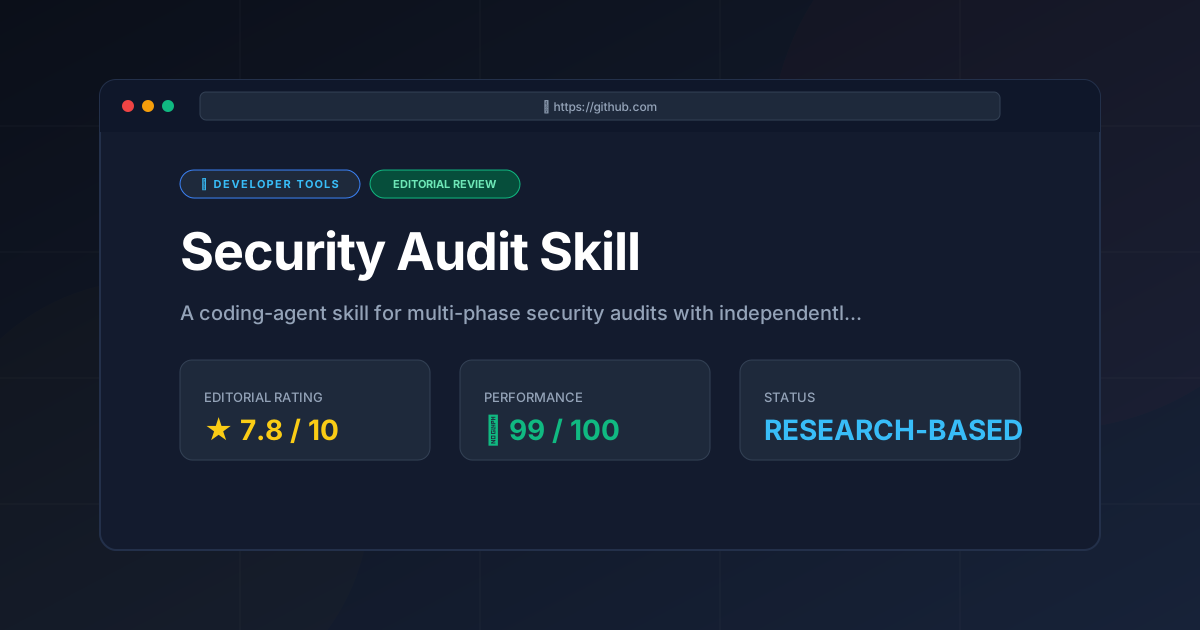
Editorial Rating: 7.8/10 #
A powerful, methodology-driven tool that trades speed and simplicity for accuracy and depth. The score reflects the high barrier to entry and the cost of inference.
More Tools Worth Reading
Warp
Developer ToolsModern terminal Warp reimagines the CLI with AI and blocks. Discover if this Rust-based powerhouse can actually boost your dev productivity.

New Tool Reviews: What PulseTools Published in 2026
Developer ToolsNew tool reviews: a dated log of every review this site has published, newest first, with the category and depth of each one, written from published r...
Windsurf
Developer ToolsAgentic IDE Windsurf analyzed: discover how its flow-state AI and deep indexing can accelerate your coding workflow. Read the full technical review.