Best AI Website Builder? Framer AI Review (2026) & Verdict
⚡ Executive Summary
ai website builder review: Discover how Framer AI transforms prompts into professional sites. Read our technical breakdown to accelerate your launch.
Disclaimer: This review is based on publicly available information, including official documentation, pricing pages, and public repositories; it is not based on a laboratory benchmark or first-person installation.
The landscape of web development has shifted from manual coding to visual editing, and now to generative creation. At the forefront of this evolution is Framer AI, a sophisticated ai website builder that allows users to bypass the traditional design phase entirely. By leveraging a Large Language Model (LLM) integrated directly into a high-fidelity design engine, Framer AI transforms a simple text prompt into a fully responsive, published website in seconds.
What is an AI Website Builder? #
An ai website builder is a design platform that uses generative artificial intelligence to automatically create website layouts, write initial copy, and select color palettes based on user prompts. Unlike traditional templates, these tools synthesize unique structures in real-time, allowing users to iterate on the visual identity and content through natural language instructions before refining the result with manual design tools.
Technical Architecture: How Framer AI Operates #
Framer AI is not merely a wrapper for a chatbot; it is a deep integration of generative AI and a React-based rendering engine. While many builders produce static HTML, Framer generates a structured design tree that remains fully editable.
The Prompt-to-Canvas Pipeline #
When a user enters a prompt, the AI processes the intent to determine the necessary sections (e.g., Hero, Social Proof, Pricing, FAQ). It then maps these requirements to a library of design patterns, applying a cohesive style guide. This process eliminates "blank canvas syndrome," providing a 70-80% complete draft that serves as a technical foundation.
Responsive Logic and "Stacks" #
One of the most critical technical aspects of the platform is the use of "Stacks." Stacks are Framer's implementation of CSS Flexbox. The AI doesn't just place elements randomly; it organizes them into logical stacks that automatically adjust based on the viewport size. This ensures that the generated site is responsive by default, reducing the need for manual breakpoint adjustments.
In-Depth Feature Breakdown & Real-World Use Cases #
1. Generative Text-to-Site Engine #
The core value of this ai website builder is its ability to interpret nuance. A prompt such as "A high-conversion landing page for a FinTech startup focusing on Gen-Z investors, using a brutalist aesthetic with neon green accents and bold typography" will result in a vastly different architectural output than a prompt for a "minimalist law firm."
Practical Configuration Workflow:
- Intent Definition: Input a detailed prompt specifying industry, target audience, and visual mood.
- Iterative Styling: Use the "Shuffle" function to cycle through AI-suggested color palettes and font pairings without altering the layout.
- Sectional Regeneration: If a specific block (like the "About" section) feels off, the AI can regenerate just that component while keeping the rest of the page intact.
2. High-Fidelity Motion and Interactivity #
Framer AI distinguishes itself from competitors by treating motion as a first-class citizen. It supports "Magic Motion," which allows for seamless transitions between states.
Use Case: A creator building a high-conversion landing page can implement scroll-triggered animations that mimic a custom-coded experience. For those looking to integrate more complex, pre-built visual elements, comparing these capabilities to the Landing Page Components: MagicUI Review (2026) & Verdict can help determine if a custom component library is needed alongside the AI generation.
3. Integrated CMS and Deployment #
The platform removes the "handoff" phase between design and development. The design is the production code. By utilizing the official Framer documentation, users can see how the integrated CMS allows for the management of dynamic content—such as blog posts or portfolio items—directly within the canvas.
Deployment Pipeline:
- Generation: AI creates the landing page.
- Data Linking: The user creates a CMS collection for "Case Studies" and links the AI-generated grid to this data source.
- Global Distribution: The site is deployed to a custom domain via Framer's global CDN, ensuring low latency worldwide.
Step-by-Step Implementation Guide #
To move from a prompt to a professional production site, follow this technical checklist:
Phase 1: The Generative Foundation #
- Account Setup: Create an account at
framer.com. - Prompt Engineering: Avoid generic terms. Use the formula:
[Page Type] + [Industry] + [Target Audience] + [Visual Style] + [Specific Elements]. - Theme Cycling: Use the AI palette generator to test 3-5 different color schemes to ensure accessibility (WCAG compliance) and brand alignment.
Phase 2: Manual Refinement #
- Stack Optimization: Review the "Stacks" to ensure padding and gaps are consistent across all sections.
- Breakpoint Audit: Switch between Desktop, Tablet, and Mobile views. Adjust the layout for mobile users, as AI-generated columns may occasionally require stacking adjustments.
- Asset Replacement: Replace AI-generated placeholder images with high-resolution, optimized WebP files to maintain fast load times.
Phase 3: Content and SEO #
- Copy Editing: AI copy is often generic. Rewrite the H1 and H2 tags to include high-intent keywords.
- Metadata Configuration: Set unique page titles and meta descriptions in the page settings.
- Internal Linking: Ensure a logical flow between the landing page and CMS pages.
Objective Pros & Cons Matrix #
| Pros | Cons |
|---|---|
| Rapid Prototyping: Reduces time-to-market from weeks to hours. | Generic Copy: AI-generated text often lacks brand voice and requires heavy editing. |
| Design Precision: Offers granular control over layout and motion compared to Wix. | Learning Curve: Mastering "Stacks" and "Frames" requires a basic understanding of box-model logic. |
| Zero Infrastructure: Integrated hosting and CMS eliminate the need for external servers. | Vendor Lock-in: Exporting to clean, portable HTML/CSS is not a primary feature. |
| Responsive by Default: AI handles the initial heavy lifting of breakpoint optimization. | SEO Depth: Lacks some of the advanced technical SEO plugins found in WordPress. |
Framer AI vs. Alternatives: Which Builder to Choose? #
When selecting an ai website builder, the choice depends on the balance between design flexibility and structural control.
| Feature | Framer AI | Webflow | Wix Studio |
|---|---|---|---|
| Primary Strength | Prompt-to-Site Speed | Professional Dev Control | All-in-one Business Suite |
| AI Integration | Deep (Layout + Copy) | Moderate (Assisted Design) | High (Section Generation) |
| Learning Curve | Low $\rightarrow$ Medium | High | Medium |
| Speed to Launch | Fastest | Slowest | Fast |
| Best For | Startups, Portfolios | Agencies, Web Apps | Small Businesses, E-commerce |
For users who find the generative approach too unpredictable and prefer a structured, manual wireframing process before moving to high-fidelity design, exploring AI Wireframing with Relume (2026): Full Review & Verdict may provide a more strategic alternative.
Pricing Tiers & Value Assessment #
Framer AI utilizes a Freemium model. For the most current rates, users should refer to the official Framer pricing page.
- Free Tier: Best for hobbyists. Includes a Framer domain and basic AI generation limits.
- Mini/Basic Tiers: Targeted at individuals needing a custom domain and a limited number of CMS pages.
- Pro Tiers: Designed for professional creators and small teams, offering increased bandwidth, advanced site analytics, and expanded CMS capabilities.
Value Analysis: For a professional freelancer, the paid tier is an investment in efficiency. The cost is negligible compared to the hours saved on manual layout construction. However, for a simple personal landing page, the free tier is remarkably capable.
Frequently Asked Questions #
Does Framer AI write the actual code for the site? #
Framer AI generates the visual layout and the underlying React-based code automatically. While users do not need to write code to launch a site, the platform supports custom code components for developers who need to implement specific third-party functionalities.
Can I import existing designs from Figma? #
Yes. Framer provides a dedicated plugin that allows users to copy-paste layers directly from Figma into the Framer canvas. This makes it a powerful hybrid tool for those who prefer to design in Figma and use the AI for rapid iteration and deployment.
Is the content generated by the AI optimized for SEO? #
The technical structure (HTML tags, loading speed) is SEO-friendly. However, the actual text generated by the AI is often too generic to rank for competitive keywords. Users must manually optimize the copy to improve search engine visibility.
Can I host my Framer AI site on my own server? #
Framer is primarily a managed hosting platform. To maintain the integrity of the complex animations and the integrated CMS, the tool is designed to be hosted on Framer's own infrastructure rather than exported to a private server.
How does the AI handle mobile responsiveness? #
The AI utilizes a "stack-based" layout system. When it generates a site, it creates a hierarchy of elements that automatically collapse or resize based on the screen width, though manual fine-tuning is recommended for complex layouts.
Final Verdict & Editorial Rating #
Framer AI is a powerhouse that successfully collapses the distance between a conceptual idea and a live URL. It is not a total replacement for a professional UI/UX designer—as the AI can still produce generic layouts—but it is an unparalleled "accelerator." It removes the friction of the initial build, allowing the creator to spend their energy on the 20% of the design that truly defines a brand.
The primary trade-off is the balance between ease of use and total architectural control. While it is significantly faster than Webflow, it does not offer the same level of absolute control over every single CSS property. However, for the target audience of creators and startup founders, this is a negligible compromise.
Who should use it?
- Freelancers & Designers: To rapidly prototype client concepts and move to production.
- Startup Founders: To launch a professional MVP landing page in a matter of hours.
- Content Creators: To build a visually stunning portfolio without hiring a dedicated developer.
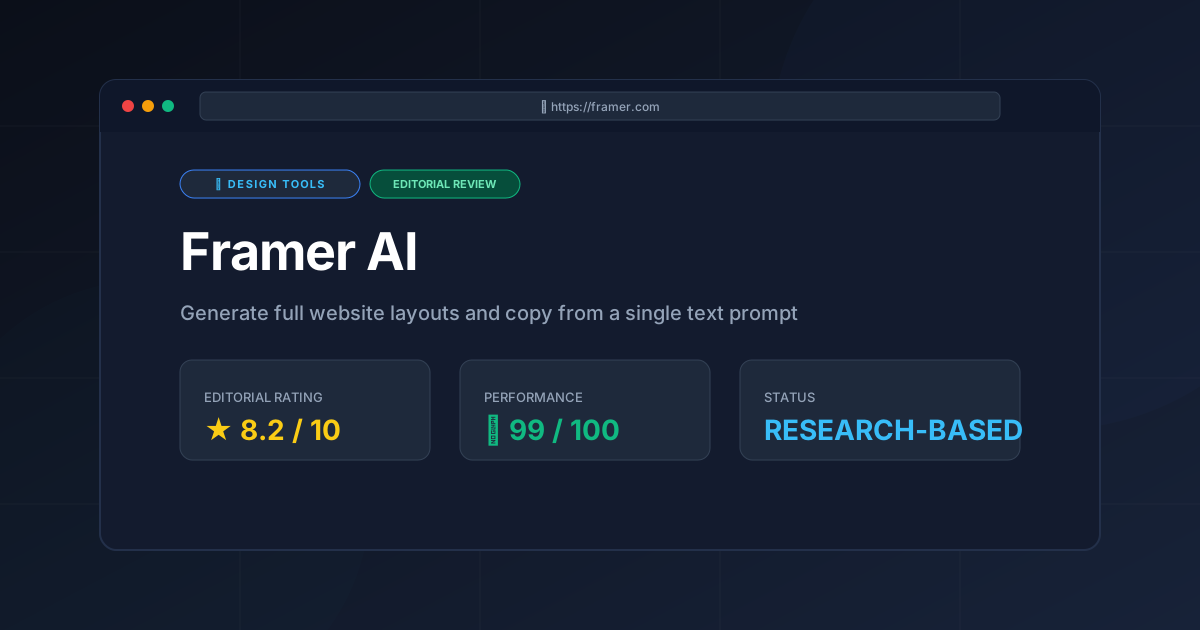
Editorial Rating: 8.2/10 #
A dominant force in the generative web space, praised for its speed and aesthetic quality, though slightly hampered by generic AI copywriting and a closed hosting ecosystem.
More Tools Worth Reading
Spline
Design ToolsWeb 3D design made easy. Explore our deep dive into Spline 2026 to see how it transforms interactive sites—read now to optimize your design stack.
Storybook
Design ToolsUI component library management made easy. Explore our deep dive into Storybook 2026 to see if it is the right fit for your design system workflow.
Storyset
Design ToolsFree vector illustrations are the core of Storyset. Learn how to customize, animate, and deploy professional SVGs to boost your site conversion rates.