LLM Observability Review: LangSmith (2026) Features & Verdict
⚡ Executive Summary
LLM observability is critical for production AI. Discover how LangSmith solves debugging and evaluation to ensure your AI agents are reliable and scalable.
Disclaimer: This review is based on publicly available information, including official documentation, pricing pages, and public repositories; it is not based on laboratory benchmarks or first-person installation tests.
Overview: What is LangSmith and Why is it Trending? #
As Large Language Model (LLM) applications move from simple chat interfaces to complex, multi-step autonomous agents, the "black box" problem has become the primary bottleneck for production deployment. Developers often struggle to identify exactly where a chain fails: Is the prompt ambiguous? Is the retrieval step returning irrelevant documents? Or is the LLM hallucinating during the final synthesis?
LangSmith is a specialized platform designed to solve these problems by providing a comprehensive suite for debugging, testing, and monitoring LLM applications. Developed by the team behind LangChain, it acts as the "Developer Tools" layer for the AI stack. While LangChain provides the orchestration framework to build the app, LangSmith provides the visibility to refine it.
The tool is trending because it addresses the critical need for llm observability. In an era where developers are integrating complex tools—similar to the automation capabilities seen in our Browser Use AI Review (2026)—the ability to trace every single token and decision point in a sequence is no longer a luxury; it is a requirement for enterprise-grade reliability.
What is LLM Observability? #
LLM observability is the technical practice of monitoring, tracing, and analyzing the internal states and outputs of large language model applications. Unlike traditional logging, it focuses on visualizing the "chain of thought," tracking token usage, measuring latency per step, and using automated evaluators to ensure output quality and factual accuracy in production.
Key Technical Specifications & Fast Facts #
| Specification | Detail |
|---|---|
| License | Proprietary / Commercial |
| Hosting Type | Cloud (SaaS) |
| Free Tier Availability | Yes (Freemium) |
| API Access | Full REST API & SDKs |
| Supported Platforms | Python, JavaScript/TypeScript |
| Primary Integration | Native LangChain integration (but supports non-LangChain apps) |
In-Depth Feature Breakdown & Real-World Use Cases #
LangSmith is not a single tool but a lifecycle management platform. Its value proposition is split across three primary pillars: Tracing, Evaluation, and Prompt Management. To fully implement llm observability, a developer must move beyond simple logs and embrace these three dimensions.
1. Trace Visualization (The Debugging Engine) #
The core of LangSmith is its tracing capability. When an LLM application runs, it often executes a "chain" of events: a prompt template is filled, a vector database is queried, and the result is passed to an LLM.
How it works: LangSmith captures the input and output of every step in this process. Instead of staring at a monolithic console log, developers see a nested tree visualization. You can click into a specific "run" to see exactly what the prompt looked like after variables were injected and exactly how long the LLM took to respond.
Real-World Use Case: Imagine a customer support bot that fails to answer a query about a specific refund policy. With tracing, a developer can see that the "Retrieval" step failed to find the correct PDF snippet, meaning the LLM was forced to guess. The fix is then applied to the embedding model or the chunking strategy, rather than wasting time tweaking the prompt.
2. Dataset Evaluation (The Testing Framework) #
Testing LLMs is notoriously difficult because outputs are non-deterministic. You cannot use simple assert output == "expected" logic.
How it works: LangSmith allows developers to create "Datasets"—collections of inputs and "golden" (ideal) outputs. You can then run your current chain against this dataset and use "Evaluators" to score the results. These evaluators can be:
- Heuristic: Checking for the presence of certain keywords.
- LLM-assisted: Using a more powerful model (like GPT-4o or Claude 3.5) to grade the response of a smaller, faster model.
Real-World Use Case: Before deploying a new version of a prompt, a developer runs the new prompt against a dataset of 100 historical customer queries. If the "Accuracy Score" drops from 85% to 70%, the deployment is blocked. This prevents regressions in production.
3. Prompt Versioning (The CMS for Prompts) #
Hard-coding prompts into Python files is a recipe for version-control nightmares. LangSmith treats prompts as managed assets.
How it works: The "Prompt Hub" allows developers to write, test, and version prompts in a web UI. The application then pulls the "latest" or a "specific version" of the prompt via an API call at runtime.
Real-World Use Case: A marketing team wants to change the "tone" of an AI agent from "Professional" to "Playful." Instead of a developer changing code, pushing to Git, and redeploying the entire container, the prompt is updated in the LangSmith Hub and takes effect immediately across all production instances.
Step-by-Step Getting Started Guide #
While we have not performed a live installation, the documented workflow for integrating LangSmith's official platform is designed to be low-friction:
- Account Setup: Create an account at
smith.langchain.comand generate an API Key. - Environment Configuration: Add the API key to your environment variables. This is the primary way the SDK handles llm observability without requiring heavy code changes:
LANGCHAIN_TRACING_V2=trueLANGCHAIN_API_KEY=your_api_key_hereLANGCHAIN_PROJECT="my-first-project"
- Integration: If using LangChain, no additional code is required; the SDK automatically detects these environment variables and begins streaming traces to the cloud. For non-LangChain apps, use the
langsmithPython wrapper to manually wrap functions with@traceable. - Observation: Run your application. Navigate to the LangSmith dashboard to view the "Runs" tab, where you can inspect the latency and token usage of every call.
- Iteration: Identify a failing run, click "Add to Dataset," and begin creating a test suite to ensure that specific failure never happens again.
Technical Trade-offs and Edge Cases #
Implementing a full llm observability stack involves several technical trade-offs that architects must consider:
Latency Overhead #
While the LangSmith SDK is designed to be asynchronous, sending every trace to a remote server introduces a non-zero amount of overhead. In ultra-low-latency environments (e.g., high-frequency trading AI), developers may need to implement "sampling," where only 1% or 5% of traces are sent to the cloud to avoid slowing down the user experience.
Data Privacy and PII #
A significant edge case occurs when LLMs process Personally Identifiable Information (PII). Because LangSmith captures the full input/output of every step, sensitive data (emails, credit card numbers) can end up in the LangSmith cloud. Organizations must implement a "scrubbing" layer—using regex or PII-detection models—before the data leaves their secure environment.
Token Cost of Evaluation #
Using "LLM-as-a-judge" for evaluation is powerful but expensive. If you have a dataset of 1,000 examples and use GPT-4o to evaluate every single one, the cost of the evaluation process can sometimes exceed the cost of the actual application development.
Objective Pros & Cons Matrix #
| Pros | Cons |
|---|---|
| Seamless Integration: Near-zero setup for LangChain users. | Vendor Lock-in: Heavy reliance on the LangChain ecosystem can make switching frameworks difficult. |
| Deep Visibility: Turns the "black box" of LLMs into a transparent, auditable flow. | Cost Scaling: As trace volume grows, the cost of monitoring can become a significant line item. |
| Collaborative: Allows non-technical stakeholders to review and edit prompts in the Hub. | Privacy Concerns: Sending all traces to a cloud provider may be a dealbreaker for highly regulated industries. |
| Rapid Iteration: The loop from "detect error" $\rightarrow$ "create test" $\rightarrow$ "fix prompt" is extremely tight. | Learning Curve: Mastering the evaluation framework requires a solid understanding of LLM metrics. |
LLM Observability: LangSmith vs. Competitors #
The observability market is crowded. While LangSmith is the "gold standard" for LangChain users, other tools offer different strengths.
| Feature | LangSmith | Arize Phoenix | Weights & Biases (W&B) |
|---|---|---|---|
| Primary Focus | Full LLM Lifecycle | Observability & Eval | ML Experiment Tracking |
| Setup Speed | Instant (for LangChain) | Fast (Open Source/Local) | Moderate |
| Hosting | SaaS | Local / Cloud | SaaS |
| Best For | Developers using LangChain | Privacy-focused/Local Eval | Data Scientists / Model Trainers |
| Pricing | Freemium | Open Source / Enterprise | Tiered / Enterprise |
For those building highly autonomous systems that interact with the web—perhaps using tools discussed in our Browser Use vs Crawl4AI comparison—LangSmith's ability to trace complex tool-calling loops is a significant advantage over traditional ML tracking tools.
Pricing Tiers & Value Assessment #
LangSmith utilizes a Freemium model. Detailed cost structures can be found on the official pricing page. While specific pricing can fluctuate, the general structure is as follows:
- Free Tier: Generally aimed at individual developers and hobbyists. It provides a limited number of traces and project slots. It is sufficient for prototyping but will be exhausted quickly in a production environment.
- Paid Tiers: These typically scale based on the volume of traces (the number of "runs" logged).
Is the paid tier worth it?
For a professional developer or a startup, yes. The cost of a single production failure—such as an AI agent hallucinating a fake discount code to a customer—far outweighs the monthly cost of monitoring. The value lies not in the "storage" of logs, but in the "reduction of time-to-fix." If LangSmith reduces your debugging time from four hours to ten minutes, the ROI is immediate.
Frequently Asked Questions #
Do I have to use LangChain to use LangSmith? #
No. While it is natively integrated with LangChain, LangSmith provides a standalone SDK. You can wrap any Python or JS function with the @traceable decorator to send data to the platform, making it a viable llm observability tool for any framework.
Is my data used to train LangChain's models? #
According to the official documentation, LangSmith is a tool for observability and does not use customer data to train the underlying models. However, users should always verify the latest Data Processing Agreement (DPA) for specific compliance needs.
How does LangSmith handle "Evaluation" differently than a unit test? #
A unit test checks for a binary Pass/Fail. LangSmith evaluations use "LLM-as-a-judge," where a model evaluates the quality, tone, and relevance of a response, providing a nuanced score rather than a simple true/false.
Can I host LangSmith on my own servers? #
LangSmith is primarily a SaaS offering. For those requiring absolute data residency, it is worth checking the official site for updates on "Self-Hosted" or "Enterprise Cloud" options, as this is a common request for corporate clients.
How does LangSmith help with "Hallucinations"? #
By providing a full trace of the retrieval step, LangSmith allows you to see if the LLM had the correct information but ignored it, or if the retrieval system failed to provide the information entirely. This distinguishes between a "retrieval error" and a "generation error."
Final Verdict & Editorial Rating #
LangSmith is a powerhouse for anyone serious about moving LLM applications from "demo" to "production." It solves the most painful part of AI development: the unpredictability of the output. By combining tracing, versioning, and evaluation into a single pane of glass, it creates a professional software engineering workflow for a medium (LLMs) that has historically lacked one.
The only significant drawbacks are the potential for cost scaling and the inherent "gravity" of the LangChain ecosystem. However, for the vast majority of developers, these are acceptable trade-offs for the sheer amount of visibility gained.
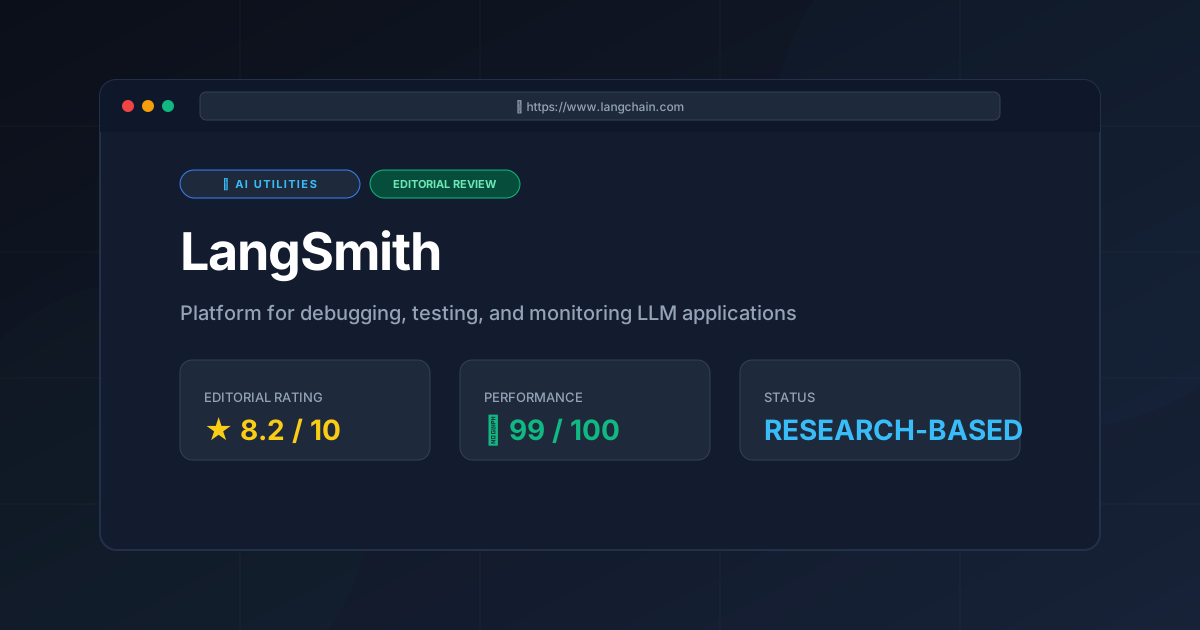
Editorial Rating: 8.2/10 #
Who should use it?
- Recommended for: AI Engineers, Full-stack developers building LLM features, and Product Managers who want to audit AI responses.
- Not recommended for: Developers building simple, single-prompt wrappers who don't need complex tracing, or organizations with strict "no-cloud" data policies.
More Tools Worth Reading
Cline
Ai UtilitiesCline AI is a powerful open-source autonomous coding agent for VS Code. Read our deep-dive review to discover its features, costs, and setup workflows...
Tavily
Ai UtilitiesAI search API Tavily reviewed for 2026. Discover how it optimizes RAG workflows and reduces LLM hallucinations to build better AI agents.
v0.dev
Ai UtilitiesAI UI generator v0.dev reviewed. Learn how this Vercel tool transforms prompts into React code to accelerate your frontend development workflow.