Share your AI Setup, Learn from others Review (2026): Best AI
⚡ Executive Summary
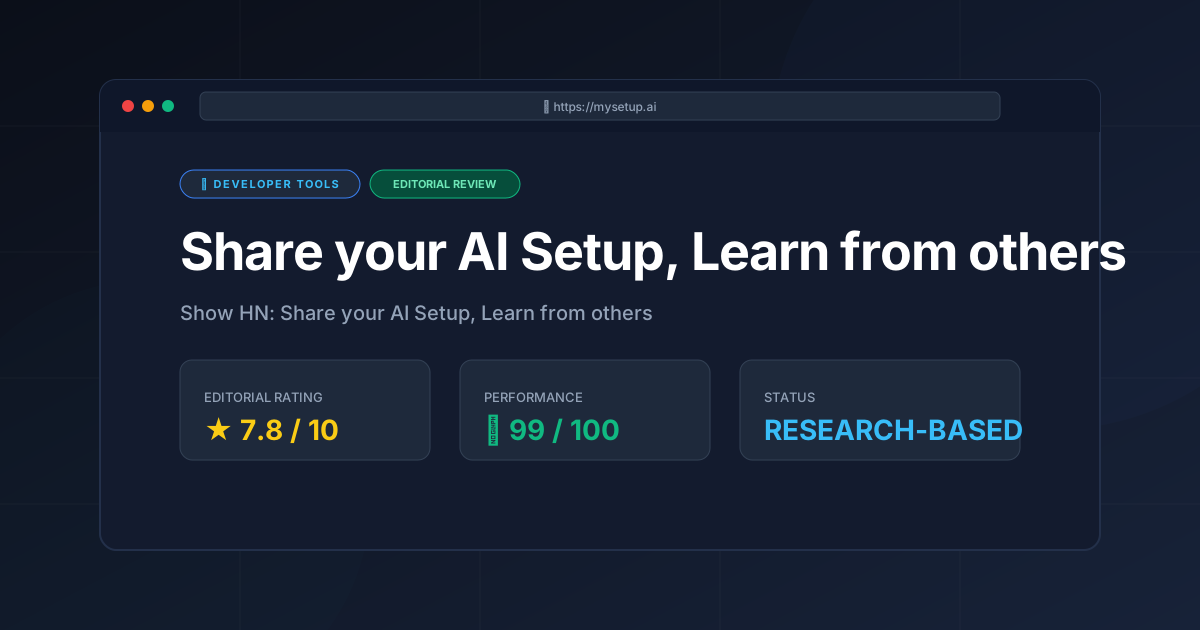
Share your AI Setup, Learn from others is a community hub for AI engineers. Discover proven tech stacks and optimize your AI development workflow today.
As the AI landscape shifts from simple prompt engineering to complex agentic workflows and multi-model orchestration, the "black box" problem has moved from the model itself to the developer's environment. Engineers are no longer just asking which LLM to use, but which combination of IDE extensions, system prompts, RAG pipelines, and local runtime environments yield the highest productivity. To solve this, many are turning to share your ai setup, learn from others to standardize their technical environments.
Disclaimer: This review is based on publicly available information, including official documentation, the public repository, and the project's landing page; it is not based on a laboratory benchmark or internal installation.
What is Share your AI Setup, Learn from others? #
Share your AI Setup, Learn from others is a community-driven platform where AI engineers document and discover the specific technical configurations used to build AI applications. It allows users to catalog their entire stack—including LLM versions, orchestration frameworks, and IDE plugins—turning individual workflows into reusable, structured blueprints for the broader developer community.
Key Technical Specifications & Fast Facts #
| Specification | Detail |
|---|---|
| License | Open Source |
| Hosting Type | Cloud-based (with self-hosting potential) |
| Free Tier Availability | Yes (Core functionality is open) |
| API Access | Available via public repository |
| Supported Platforms | Web-based / Cross-platform |
In-Depth Feature Breakdown & Real-World Use Cases #
The utility of this platform lies in its ability to turn subjective "vibes" into objective technical configurations. By allowing users to share your ai setup, learn from others, the tool eliminates the guesswork involved in assembling a modern AI stack.
1. Structured Setup Cataloging #
Instead of a wall of text, the tool encourages a modular breakdown of a developer's environment. This typically includes the Model Layer (e.g., GPT-4o, Claude 3.5 Sonnet, Llama 3), the Orchestration Layer (e.g., LangChain, CrewAI), and the Tooling Layer (e.g., Cursor, VS Code extensions).
Real-World Use Case: A developer building a high-throughput coding assistant might share a setup that combines a local Llama 3 instance for autocomplete with a cloud-based Claude 3.5 for complex architectural reasoning. By documenting this "hybrid" approach, other engineers can replicate the latency-vs-quality trade-off without trial-and-error.
2. Production Developer Workflow Templates #
The platform focuses on "Production" workflows rather than "Hello World" examples. This means the shared configurations often include details on how AI is integrated into the CI/CD pipeline or how prompt versioning is handled.
Real-World Use Case: If you are integrating a backend for your AI app, you might find a setup that utilizes a specific PostgreSQL configuration for vector embeddings. For those looking for a managed alternative to handle the database side of these setups, our Supabase Review (2026): The Best Backend as a Service for provides a deep dive into how to scale such infrastructures.
3. Community-Driven Knowledge Exchange #
The "learn from others" aspect is the engine of the platform. By browsing setups by category or "stack," developers can identify emerging patterns—such as the shift toward "Agentic" workflows.
Real-World Use Case: An engineer transitioning from standard LLM calls to autonomous agents can browse setups to see which frameworks are actually being used in production. This is particularly useful when deciding on a framework; for instance, if you are comparing agentic architectures, you might cross-reference these setups with our Agent Native Review (2026): Best Framework for Agentic Apps? to see if the community's preferred setups align with the framework's technical capabilities.
Technical Implementation: How to Optimize Your AI Stack #
To get the most out of the platform, users should follow a rigorous documentation process. Simply listing a model is insufficient; high-value entries provide the "connective tissue" of the architecture.
Configuration Checklist for High-Value Setups #
When you share your ai setup, learn from others, ensure you include the following technical details to maximize utility:
- Model Parameters: Specify temperature, top-p, and frequency penalties.
- Context Window Management: Detail how you handle token limits (e.g., sliding window, summarization).
- RAG Architecture: List the embedding model and the vector database used.
- Runtime Environment: Specify the OS, Python/JS version, and any hardware acceleration (e.g., CUDA versions).
Edge Cases and Trade-offs #
Users should be aware of the trade-offs when replicating a shared setup. A configuration optimized for a high-end NVIDIA H100 cluster will not perform identically on a MacBook M3. When browsing the platform, look for "Hardware Constraints" notes to ensure the setup is compatible with your local resources.
Step-by-Step Getting Started Guide #
Since the tool is open source and web-accessible, the barrier to entry is low.
- Visit the Portal: Navigate to the official site.
- Create Your Profile: Sign up to establish your identity as a developer. This allows you to build a portfolio of your AI configurations.
- Define Your Stack:
- Models: List the primary and secondary LLMs you use.
- Tools: Add your IDEs (e.g., Cursor, Windsurf) and plugins.
- Frameworks: Specify if you are using LangGraph, AutoGen, or custom scripts.
- Document the "Why": Add notes to your setup explaining why you chose a specific model over another (e.g., "Used Claude 3.5 for better XML adherence in tool calling").
- Publish and Explore: Make your setup public to contribute to the community and use the search/filter functions to find setups that match your current project goals.
Objective Pros & Cons Matrix #
| Pros | Cons |
|---|---|
| Open Source Transparency: The open source license ensures the community can audit and improve the platform. | Lack of Versioning: Currently functions as a static snapshot rather than a version-controlled history of a setup. |
| High Signal-to-Noise: Focuses on full environments rather than isolated prompts, avoiding typical "AI hack" fluff. | Manual Entry Friction: No automatic "export" from IDEs; users must manually input their configurations. |
| Zero Cost Entry: The open-source nature makes it accessible to indie hackers and students globally. | Verification Gap: No built-in "verified" badge to prove a setup actually works in a production environment. |
| Accelerates Onboarding: New AI engineers can skip months of experimentation by copying proven, professional stacks. | Niche User Base: Highly technical focus means it lacks the polished UX of commercial SaaS tools. |
Share your AI Setup, Learn from others vs. Competitors #
While there are many "AI Directories," few focus specifically on the developer's environment. Most competitors are either prompt libraries or model aggregators.
| Feature | Share your AI Setup | Prompt Libraries | GitHub Gists/Repos |
|---|---|---|---|
| Focus | Full Dev Environment | Individual Prompts | Raw Code/Configs |
| Structure | Categorized Stack | Text-based | Unstructured |
| Discovery | Setup-based Filtering | Keyword Search | Repository Search |
| Pricing | Open Source | Mixed (Freemium) | Free |
| Best For | AI Architects & Engineers | Prompt Engineers | Software Developers |
For those who prefer a more integrated, "all-in-one" development experience where the setup is handled by the tool itself, it is worth comparing this community approach to the automated environment generation found in our Bolt.new Review (2026): Features, Pricing & Verdict.
Pricing Tiers & Value Assessment #
Pricing Model: Open Source
Because the tool is open source, the primary value proposition is free access to community knowledge. There are no traditional "paid tiers" mentioned in the core project documentation that lock essential features behind a paywall.
Value Assessment:
The value is exceptionally high for the individual developer. The "cost" is primarily the time spent documenting your own setup to give back to the community. For organizations, the value lies in the ability to potentially self-host a private version of the tool to standardize AI setups across internal engineering teams, ensuring that every developer is using the same approved models and security wrappers.
Frequently Asked Questions #
Is this just a place to share prompts? #
No. While prompts are part of an AI setup, this tool focuses on the infrastructure—the models, the IDEs, the runtime environments, and the orchestration frameworks. It is about the "how" and "where," not just the "what."
Can I keep my setup private? #
Based on the current public-facing model, the goal is community sharing. However, since it is open source, developers can deploy their own instance of the platform to maintain private internal documentation for their teams.
Does it integrate with my IDE? #
Currently, it is a standalone platform for documentation and discovery. It does not automatically sync with your .vscode or .cursor settings, meaning all entries must be added manually by the user.
Who is this tool NOT for? #
It is not for non-technical users looking for "AI shortcuts." It is designed for developers who understand the difference between a system prompt and a temperature setting and want to optimize their professional workflow.
How does it differ from a GitHub README? #
While a README describes a project, this tool describes the environment used to build it. It provides a structured, searchable format that allows you to compare stacks across different users, which is difficult in unstructured markdown files.
Final Verdict & Editorial Rating #
Editorial Rating: 7.8/10
Share your AI Setup, Learn from others is a vital utility for the maturing AI engineering ecosystem. It transforms the tribal knowledge of "how the pros build" into a searchable, structured database. Its greatest strength is its focus on the entire stack rather than just the model.
However, the tool's reliance on manual data entry is a significant friction point. To move from a 7.8 to a 9.0, the project would need to implement "Setup Import" capabilities (e.g., importing a package.json or a Cursor config file) to automate the cataloging process.
Who should use it?
- AI Engineers who want to benchmark their stack against industry peers.
- Technical Leads looking to standardize AI tooling across a development team.
- Junior Developers who are overwhelmed by the number of available AI tools and need a proven starting point.
- Open Source Enthusiasts who believe in the democratization of technical workflows.
More Tools Worth Reading
Warp
Developer ToolsModern terminal Warp reimagines the CLI with AI and blocks. Discover if this Rust-based powerhouse can actually boost your dev productivity.
New Tool Reviews: What PulseTools Published in 2026
Developer ToolsNew tool reviews: a dated log of every review this site has published, newest first, with the category and depth of each one, written from published r...
Windsurf
Developer ToolsAgentic IDE Windsurf analyzed: discover how its flow-state AI and deep indexing can accelerate your coding workflow. Read the full technical review.