Open Source Firebase Alternative: Supabase Review (2026)
⚡ Executive Summary
Open source firebase alternatives are evolving. Discover if Supabase is the right backend for your 2026 project with our deep technical analysis.
Disclaimer: This review is based on publicly available information, including official documentation, pricing pages, and public repositories; it is not based on internal laboratory benchmarks.
Overview: The Evolution of the Backend as a Service #
For years, developers faced a binary choice: spend weeks configuring a custom VPS with a database and API layer, or surrender their data to a proprietary ecosystem. The rise of the open source firebase model has fundamentally changed this dynamic. Supabase has emerged as the leading contender in this space, promising the rapid deployment speed of a managed service without the restrictive vendor lock-in.
While many describe it simply as a clone, Supabase is technically a sophisticated orchestration of existing open-source tools. Instead of a proprietary NoSQL document store, it leverages PostgreSQL, providing a relational foundation that allows for complex queries, strict data typing, and ACID compliance. This shift is critical for 2026's application landscape, where data integrity and relational mapping are once again prioritized over the "schemaless" chaos of early NoSQL trends.
What is an Open Source Firebase Alternative? #
An open source firebase alternative is a Backend-as-a-Service (BaaS) that provides database management, authentication, and file storage through an open-source codebase. Unlike proprietary platforms, these tools allow developers to self-host their entire infrastructure via Docker, ensuring full data sovereignty and preventing pricing traps associated with closed ecosystems.
Key Technical Specifications & Fast Facts #
| Specification | Detail |
|---|---|
| License | Open Source (Apache 2.0 / MIT components) |
| Hosting Type | Managed Cloud or Self-Hosted (Docker) |
| Free Tier Availability | Yes (Generous free tier for small projects) |
| API Access | REST (via PostgREST), GraphQL, and Client SDKs |
| Supported Platforms | Web, iOS, Android, Flutter, React Native |
| Primary Database | PostgreSQL |
In-Depth Feature Breakdown & Real-World Use Cases #
1. The PostgreSQL Core & Realtime Engine #
The defining characteristic of this open source firebase implementation is its reliance on PostgreSQL. You aren't limited to a proprietary API; you can write raw SQL, create complex views, and implement stored procedures.
The "Realtime" aspect is achieved by listening to PostgreSQL's replication stream. When a row is inserted, updated, or deleted, Supabase broadcasts that change via WebSockets to subscribed clients.
Practical Workflow:
Imagine a collaborative project management tool. Instead of polling the server every 10 seconds to see if a task status changed, a developer can use the Supabase client:
const channel = supabase
  .channel('schema-db-changes')
  .on('postgres_changes',
      { event: 'UPDATE', schema: 'public', table: 'tasks' },
      (payload) => console.log('Change received!', payload)
  )
  .subscribe()
This enables "Google Docs-style" reactivity without writing a custom WebSocket server. For those comparing this to other managed Postgres options, our Supabase Review (2026): The Best Backend as a Service for provides further context on the PostgreSQL ecosystem.
2. Supabase Auth & Row Level Security (RLS) #
Supabase Auth provides a complete user management system handling sign-ups, logins, and password resets. However, its true power lies in its integration with Row Level Security (RLS).
In a traditional setup, you write middleware to check if user_id matches the resource owner. In Supabase, you define the security policy directly in the database:
-- Only allow users to read their own profiles
CREATE POLICY "User can view own profile"
ON profiles FOR SELECT
USING (auth.uid() = id);
This ensures that even if a malicious actor bypasses your frontend, the database itself rejects unauthorized requests. For those building complex AI-driven interfaces, integrating this secure backend with a modern frontend is often streamlined by tools like Bolt.new Review (2026): Features, Pricing & Verdict, which accelerates the scaffolding of such applications.
3. Edge Functions & Storage #
Supabase Edge Functions are serverless TypeScript functions executed globally via Deno. This allows developers to run backend logic (like processing payments via Stripe or sending emails) without managing a full Node.js server.
Combined with Supabase Storage—which handles large files like images and videos—developers can create a seamless pipeline: a user uploads a profile picture to Storage, which triggers an Edge Function to resize the image, which then updates the user's record in the PostgreSQL database.
Step-by-Step Implementation Guide #
To deploy a production-ready backend, follow this technical checklist:
- Project Initialization: Create an account at
supabase.com. Set a strong database password; this provides full administrative access to your Postgres instance. - Schema Design: Use the Table Editor GUI or the SQL Editor to define your tables.
- Example: Create a
profilestable withid (uuid),username (text), andupdated_at (timestamp).
- Enable RLS: This is the most critical step. Navigate to the "Authentication" tab and enable Row Level Security for every table.
- Define Policies: Create a policy for each action (SELECT, INSERT, UPDATE, DELETE).
- Tip: Use
auth.uid()to restrict data access to the authenticated user.
- Client Integration: Install the SDK:
npm install @supabase/supabase-js. - Environment Configuration: Store your
SUPABASE_URLandSUPABASE_ANON_KEYin a.envfile. - Data Fetching: Implement CRUD operations:
const { data, error } = await supabase.from('profiles').select('*').eq('id', userId)
Honest Technical Trade-offs & Limitations #
While Supabase is powerful, it is not a silver bullet. Based on the official documentation, there are four concrete limitations developers must consider:
- The RLS Learning Curve: Unlike traditional Express or NestJS middleware where logic is written in JavaScript, Supabase security is written in SQL. For developers not fluent in SQL, writing complex RLS policies is error-prone and can lead to catastrophic data leaks if a policy is accidentally set to
true. - Cold Start Latency: Edge Functions, while globally distributed, are subject to "cold starts." If a function hasn't been called recently, the first request can experience a noticeable delay (often 200ms to 1s), which may be unacceptable for high-frequency, low-latency API endpoints.
- Database Management Overhead: Because you have a full Postgres instance, you are responsible for database health. As your data grows, you must manually manage indexes, analyze query performance using
EXPLAIN ANALYZE, and handle vacuuming. It is not "zero-maintenance." - NoSQL Flexibility Gap: If your application requires a truly polymorphic data structure (where every document in a collection has completely different fields), the relational nature of Postgres becomes a hindrance. While JSONB columns exist, they lack the native indexing efficiency of a dedicated document store like MongoDB.
Supabase vs. Competitors: Direct Comparison #
| Feature | Supabase | Firebase | Appwrite |
|---|---|---|---|
| Database Type | Relational (PostgreSQL) | NoSQL (Firestore) | NoSQL-like (MariaDB) |
| Open Source | Yes | No | Yes |
| Realtime | Yes (via Postgres) | Yes (Native) | Yes |
| Auth | Integrated (JWT/RLS) | Integrated | Integrated |
| Pricing | Freemium / Usage | Freemium / Usage | Freemium / Self-host |
| Best For | Data-heavy, relational apps | Rapid prototyping | Privacy-focused self-hosting |
Pricing Tiers & Value Assessment #
Supabase utilizes a tiered pricing model detailed on their pricing page.
- Free Tier: Excellent for MVPs. It includes a generous amount of database space and MAU. However, projects are paused after a period of inactivity, which can be disruptive for low-traffic apps.
- Pro Tier: The standard for startups. It removes project pausing and increases limits for storage and bandwidth.
- Enterprise: Custom SLAs and enhanced security compliance for large-scale organizations.
Value Analysis:
The Pro tier is a justifiable expense because you are paying for the management of a world-class database. Unlike proprietary services, you aren't paying for "magic" that locks you in; you are paying for the convenience of not having to manage Linux servers and Postgres backups manually.
Frequently Asked Questions #
Can I host Supabase on my own servers? #
Yes. Because it is an open source firebase alternative, you can self-host the entire stack using Docker. This allows for total data sovereignty and avoids cloud provider lock-in, making it ideal for projects with strict regulatory requirements.
How does Supabase handle scaling? #
Scaling follows standard PostgreSQL patterns. For the managed service, Supabase handles the underlying hardware. For very large datasets, users should implement proper indexing and utilize read-replicas, which are available in the higher-tier plans to distribute query loads.
Is Supabase secure enough for production? #
Yes, provided Row Level Security (RLS) is correctly implemented. The security model shifts responsibility from the application server to the database. If RLS is disabled or poorly configured, your data is exposed. If configured correctly, it is exceptionally secure.
Does it support GraphQL? #
Yes. While the primary client uses a REST-like syntax via PostgREST, Supabase provides a GraphQL API (via pgloader/pgraphql) that allows you to query your database using GraphQL syntax for more complex data requirements.
How does it compare to a custom Node.js backend? #
Supabase replaces the need for a custom API layer for most CRUD operations. However, for extremely complex business logic that requires heavy computation, you will still need to use Edge Functions or a separate backend server.
Final Verdict & Editorial Rating #
Supabase is a masterclass in modern developer tooling. By combining the reliability of PostgreSQL with the convenience of a BaaS, it eliminates the "boring" parts of backend development without sacrificing the power of a relational database.
It is not a perfect tool for every project. The shift toward SQL-based security (RLS) requires a mindset change, and the cold starts of Edge Functions can be a bottleneck for certain use cases. However, for the vast majority of web and mobile applications, the trade-off is overwhelmingly positive.
For those building high-performance applications, pairing Supabase with a fast runtime—such as the options explored in our JS Runtime Review: Is Bun the Fastest Choice for 2026?—can create a formidable technical stack.
Who should use Supabase?
- Developers who want the speed of Firebase but the power of SQL.
- Startups that want to avoid vendor lock-in.
- Teams building data-intensive applications with complex relationships.
Who should avoid it?
- Developers with a strong aversion to SQL.
- Projects with extremely simple, flat data structures where NoSQL is objectively more efficient.
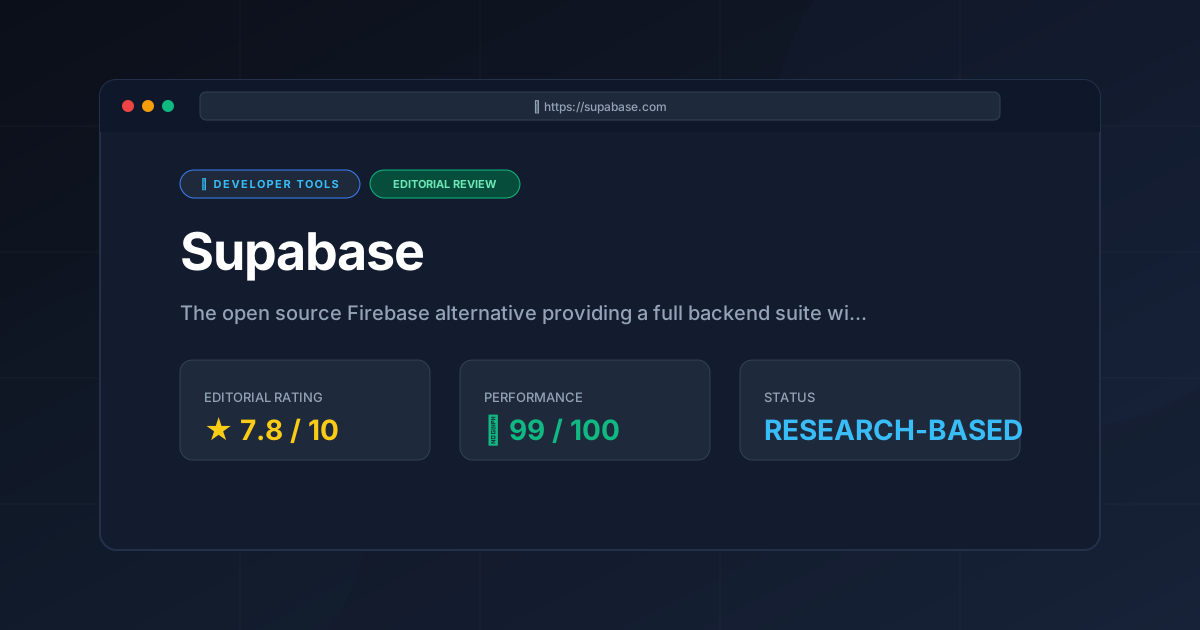
Editorial Rating: 7.8/10 #
A powerful, transparent, and highly scalable backend suite. While the RLS learning curve and Edge Function cold starts prevent a perfect score, it remains the gold standard for the open source firebase movement.
More Tools Worth Reading
Warp
Developer ToolsModern terminal Warp reimagines the CLI with AI and blocks. Discover if this Rust-based powerhouse can actually boost your dev productivity.
New Tool Reviews: What PulseTools Published in 2026
Developer ToolsNew tool reviews: a dated log of every review this site has published, newest first, with the category and depth of each one, written from published r...
Windsurf
Developer ToolsAgentic IDE Windsurf analyzed: discover how its flow-state AI and deep indexing can accelerate your coding workflow. Read the full technical review.