AI Search Engine Review: Perplexity AI (2026) Features & Verdict
⚡ Executive Summary
AI search engine Perplexity AI reviewed. Discover how its RAG architecture and real-time citations outperform traditional search for research. Read more now.
Disclaimer: This review is based on publicly available information, including official documentation, pricing pages, and public repositories, and is not a laboratory benchmark.
The traditional search engine paradigm—a list of blue links requiring the user to click, scan, and synthesize—is undergoing a fundamental shift. At the forefront of this transition is Perplexity AI, a sophisticated AI search engine that reimagines how we retrieve information. Rather than acting as a directory, Perplexity positions itself as an "answer engine." By combining the conversational capabilities of Large Language Models (LLMs) with real-time web indexing, it attempts to solve the "hallucination" problem inherent in standard chatbots by anchoring every claim in a verifiable source.
What is an AI Search Engine? #
An AI search engine is a discovery tool that uses retrieval-augmented generation (RAG) to browse the live web, extract relevant data from multiple sources, and synthesize a direct, conversational answer. Unlike standard LLMs, it provides inline citations to verify facts, combining the speed of a chatbot with the accuracy of a traditional search engine.
Overview: Why Perplexity AI is Leading the Shift #
Perplexity AI is an AI-powered research and discovery tool designed to provide direct, cited answers to complex queries. Unlike traditional LLMs that rely on a static training cutoff date, Perplexity utilizes a RAG architecture. This means that when a user submits a query, the system searches the live web, retrieves relevant snippets from multiple sources, and synthesizes those snippets into a coherent response with inline citations.
The tool is trending because it bridges the gap between the efficiency of a chatbot and the reliability of a search engine. For professionals, developers, and researchers, the value proposition is clear: it reduces the "time-to-answer" by eliminating the need to manually open ten different browser tabs to verify a single fact.
Key Technical Specifications & Fast Facts #
| Specification | Detail |
|---|---|
| License | Proprietary |
| Hosting Type | Cloud-based (SaaS) |
| Free Tier Availability | Yes (Freemium) |
| API Access | Available (via Perplexity API Documentation) |
| Supported Platforms | Web, iOS, Android |
In-Depth Feature Breakdown & Real-World Use Cases #
Perplexity AI is more than a simple wrapper for a search API. Its utility lies in how it handles the flow of information from the web to the user.
1. Real-Time Web Search & Source Citations #
The core engine does not just "predict" the next token; it retrieves data. When a query is entered, this AI search engine identifies the most authoritative sources available in real-time. The output includes numbered citations that link directly to the source material.
Practical Workflow: Technical Due Diligence
Imagine a developer needing to compare two emerging JavaScript libraries. Instead of searching "Library A vs Library B" and reading three conflicting blog posts, the developer can ask: "Compare the memory overhead of Library A and Library B based on the latest 2026 benchmarks." Perplexity will scan recent documentation and GitHub discussions, providing a synthesized comparison with links to the specific benchmark pages.
2. Pro Discovery Mode (Guided Search) #
While standard search is linear, "Pro" mode is iterative. If a query is ambiguous, Perplexity doesn't guess; it asks clarifying questions. This transforms the search process into a dialogue, ensuring the final answer is tailored to the user's specific constraints.
Practical Workflow: Market Research
A professional researching "The current state of the EV market in Southeast Asia" might find the initial result too broad. In Pro mode, Perplexity might ask: "Are you interested in consumer adoption rates, government subsidies, or infrastructure development?" By narrowing the scope, the tool avoids generic summaries and delivers high-density, actionable data.
3. Pages and Content Synthesis #
Perplexity has evolved to allow users to convert their research threads into "Pages"—structured, publishable reports. This moves the tool from a search utility to a knowledge management system. For those looking to automate the gathering of this data at scale, integrating this with a Browser Use AI Review (2026): Features, Pricing & Verdict approach can help users understand how AI agents navigate the web to feed such engines.
4. File Upload and Analysis #
Users can upload PDFs, CSVs, or text files to combine private data with public web knowledge. This is particularly useful for analyzing a company's annual report (private file) against industry trends (public web).
Step-by-Step Getting Started Guide #
To maximize the utility of this AI search engine, follow these configuration steps:
- Account Creation: Visit perplexity.ai. While basic searches can be done without an account, creating one allows you to save "Threads" and customize your "AI Profile."
- Configure Your Profile: Navigate to the settings to set your "AI Profile." Here, you can tell the engine who you are (e.g., "I am a Senior DevOps Engineer") and how you prefer your answers (e.g., "Concise, technical, and focused on scalability").
- Executing Your First Search: Enter a query in the main search bar. For factual queries, use the "All" focus. For academic research, switch the "Focus" button to "Academic" to prioritize peer-reviewed journals.
- Refining the Answer: Review the citations. If the answer is incomplete, use the "Related" questions suggested at the bottom of the page to dive deeper into specific sub-topics.
- Organizing Knowledge: Click the "Convert to Page" or "Save" button to archive your research for future reference.
Objective Pros & Cons Matrix #
| Pros | Cons |
|---|---|
| Verifiability: Inline citations significantly reduce the risk of hallucinations. | Source Dependency: If the top search results are incorrect or biased, the AI summary will be too. |
| Efficiency: Synthesizes multiple web pages into a single, readable answer. | Depth Limitations: May struggle with extremely nuanced, multi-step logical reasoning compared to standalone LLMs. |
| Currentness: Real-time indexing ensures information is up-to-date. | UI Complexity: The transition between "Quick" and "Pro" modes can be confusing for new users. |
| Focus Modes: Ability to restrict searches to Reddit, Academic papers, or YouTube. | Privacy Trade-offs: Data sent to the engine is subject to the provider's privacy policy. |
Perplexity AI vs. Alternatives: Which AI Search Engine Wins? #
Perplexity occupies a unique space between a traditional search engine and a generative AI.
| Feature | Perplexity AI | Google Search | You.com |
|---|---|---|---|
| Primary Output | Synthesized Answer | List of Links | Hybrid (Links + AI) |
| Citations | Deeply integrated/Inline | External (via links) | Integrated |
| Speed | Fast (Generative) | Instant (Indexing) | Moderate |
| Pricing | Freemium | Free (Ad-supported) | Freemium |
| Best For | Rapid Research & Fact-finding | Broad Discovery/Local Search | Power Users/Custom AI |
While Google remains the king of local intent (e.g., "pizza near me"), Perplexity is superior for informational intent (e.g., "How does the new EU AI Act affect SaaS startups?"). For those who require even more automation in how they interact with the web, comparing this to a Browser Use vs Crawl4AI: Which Is Better? analysis reveals that Perplexity is a consumption tool, whereas those are extraction tools.
Pricing Tiers & Value Assessment #
Perplexity operates on a Freemium model, as detailed on their official pricing page.
- Free Tier: Provides unlimited basic searches and a limited number of Pro searches. This is sufficient for casual users and students.
- Pro Tier: Offers a monthly subscription that grants expanded access to advanced LLMs (allowing users to toggle between different model families), increased file upload limits, and more Pro Discovery queries.
Is the Pro tier worth it?
For the average user, the free tier is remarkably capable. However, for researchers and developers, the Pro tier is a high-value investment. The ability to switch models allows users to verify a result across different AI architectures, and the increased "Pro" query limit is essential for deep-dive research projects that require 20+ iterative queries.
Frequently Asked Questions #
Does Perplexity AI replace Google? #
Not entirely. Perplexity is an AI search engine focused on answers, whereas Google is a discovery engine. For navigating to a specific website or finding local services, Google is faster. For synthesizing information from multiple sources, Perplexity is significantly more efficient.
How accurate are the citations? #
Generally high, but not infallible. Perplexity points to the source it used to generate the text. However, users should still click the citations to ensure the AI hasn't taken a quote out of context or misinterpreted a complex technical table.
Can I use Perplexity for academic writing? #
Yes, especially using the "Academic" focus mode. However, it should be used as a research assistant to find sources and synthesize themes, not as a ghostwriter, to maintain academic integrity and avoid plagiarism.
Is my data used to train their models? #
This varies by tier and setting. Users should check the official privacy settings on the Perplexity site to opt-out of data training where available. Enterprise users typically have stricter data silos.
How does it handle conflicting information? #
When sources disagree, the AI search engine typically presents both viewpoints, citing the respective sources for each. This allows the user to evaluate the credibility of the conflicting claims manually.
Final Verdict & Editorial Rating #
Perplexity AI represents a significant leap in how we interact with the internet. By treating the web as a database to be queried rather than a library to be browsed, it solves the primary pain point of the modern information age: information overload.
The tool is not without flaws. It is fundamentally dependent on the quality of the indexed web; if the internet is wrong, Perplexity will be confidently wrong. Furthermore, it lacks the deep, creative "reasoning" capabilities of a dedicated LLM like those found in a Claude Artifacts Review (2026): Features, Pricing & Verdict environment, where the focus is on creation rather than retrieval.
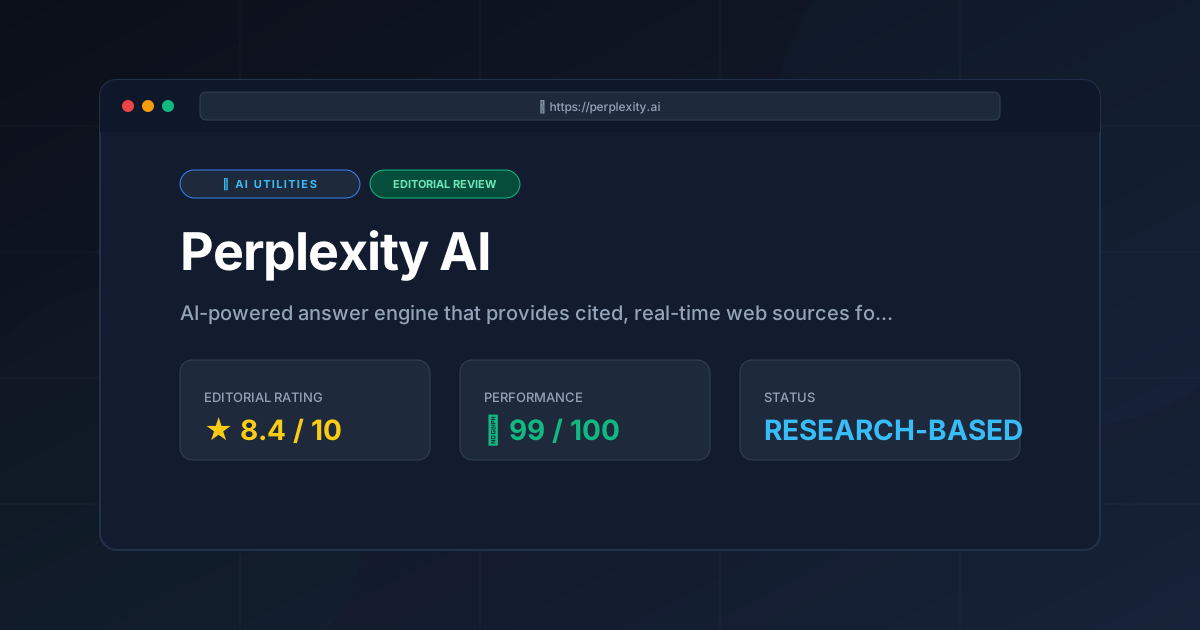
Editorial Rating: 8.4/10
Who should use it?
- Researchers: Who need to synthesize large amounts of web data quickly.
- Developers: Who need up-to-date documentation without digging through forums.
- Professionals: Who require cited evidence for their reports and presentations.
- Students: Who want a starting point for academic exploration.
More Tools Worth Reading
Cline
Ai UtilitiesCline AI is a powerful open-source autonomous coding agent for VS Code. Read our deep-dive review to discover its features, costs, and setup workflows...
v0.dev
Ai UtilitiesAI UI generator v0.dev reviewed. Learn how this Vercel tool transforms prompts into React code to accelerate your frontend development workflow.
Vercel v0
Ai UtilitiesAI UI generator Vercel v0 reviewed. Learn how to automate React and Tailwind CSS components to accelerate your frontend development workflow today.