Privacy Analytics Review: Plausible Guide for 2026
⚡ Executive Summary
Privacy analytics starts here. Discover if Plausible is the right GDPR-compliant alternative for your site to boost speed and user trust.
Disclaimer: This review is based on publicly available information, including official documentation, pricing pages, and public repositories; it is not a laboratory benchmark.
As the digital landscape shifts toward stricter data sovereignty and user privacy, the "industry standard" for web analytics has come under intense scrutiny. For years, webmasters relied on heavyweight tools that required intrusive cookie banners and complex consent management platforms. Plausible has emerged as a leading contender in the privacy analytics movement, positioning itself not just as a tool, but as a philosophical shift in how we measure web traffic without compromising the end-user's anonymity.
What is Privacy Analytics? #
Privacy analytics refers to the practice of collecting website traffic data and user behavior metrics without utilizing personally identifiable information (PII), persistent cookies, or cross-site tracking. These tools allow site owners to understand growth and engagement while remaining compliant with global data laws like GDPR and CCPA by design.
Overview: Why Plausible is Trending #
Plausible is a lightweight, open-source website analytics tool designed to provide essential traffic data without compromising user privacy. Unlike traditional platforms that track individual users via persistent cookies and build detailed behavioral profiles, Plausible uses a privacy-first approach that aggregates data without storing PII.
The tool is trending primarily because of the increasing friction between global privacy laws (GDPR, CCPA, ePrivacy Directive) and traditional tracking methods. For webmasters, "cookie banner fatigue" is real; users often ignore or reject banners, leading to skewed data. Plausible solves this by eliminating the need for cookies entirely, allowing site owners to gather accurate metrics while remaining compliant with GDPR. It appeals to those who want a "Google Analytics alternative" that is fast, ethical, and easy to digest.
Key Technical Specifications & Fast Facts #
| Specification | Detail |
|---|---|
| License | AGPLv3 (Open Source) |
| Hosting Type | Cloud (SaaS) or Self-Hosted |
| Free Tier Availability | No (Paid SaaS; Free if self-hosted) |
| API Access | Yes (REST API available) |
| Supported Platforms | Any website (HTML, JS, CMS, Static Site Generators) |
In-Depth Feature Breakdown & Real-World Use Cases #
Plausible focuses on "essentialism." Rather than providing thousands of vanity metrics, it focuses on the KPIs that actually drive business decisions.
1. GDPR Compliance & Cookie-less Tracking #
The core value proposition of Plausible is its adherence to privacy laws. It does not use cookies and does not track users across different websites. Instead, it uses a unique hash generated from the user's IP address, user agent, and a daily rotating salt. This hash is not stored permanently, meaning the site owner cannot "follow" a specific person over time.
Real-World Use Case: A European-based e-commerce store wants to avoid the legal overhead of maintaining a complex consent management platform. By implementing Plausible, they can remove their cookie banner for analytics purposes, improving the User Experience (UX) and increasing the percentage of tracked visits since users no longer have to "Accept" tracking to be counted.
2. Lightweight Script Performance #
Traditional analytics scripts are often bloated, adding significant latency to the "Time to Interactive" (TTI) metric. Plausible's script is significantly smaller (often cited as being roughly 45x smaller than Google Analytics).
Workflow Example:
To implement Plausible, a developer simply adds a single line of code to the <head> of their HTML:
<script defer data-domain="yourdomain.com" src="https://plausible.io/js/script.js"></script>
Because the script is deferred and lightweight, it has a negligible impact on Core Web Vitals. This is critical for those following an AdSense Approval Checklist 2026: Get Your Site Approved Fast to ensure high site performance and low bounce rates.
3. Simplified Dashboard & Goal Tracking #
Plausible replaces complex "Reports" sections with a single-page dashboard. It tracks visitors, page views, bounce rates, and referrers in a clean, chronological view. Goal tracking is handled via simple event triggers rather than complex "conversion funnels."
Practical Example:
If a webmaster wants to track how many people clicked a "Download PDF" button, they can add a simple attribute to their HTML:
<a href="/guide.pdf" plausible="Download Guide">Download Now</a>
The dashboard then displays this as a "Goal," providing a clear conversion rate without requiring a deep dive into a configuration menu.
Technical Implementation: Step-by-Step Guide #
While Plausible is designed for simplicity, the setup varies depending on whether you choose the hosted version or the self-hosted route.
Option A: Plausible Cloud (SaaS) #
- Account Creation: Sign up at the official Plausible website and select a plan based on your monthly page view volume.
- Domain Addition: Enter the domain you wish to track in the dashboard.
- Script Integration: Copy the provided JavaScript snippet and paste it into the
<head>section of your website. - Verification: Visit your site; the dashboard will begin reflecting real-time data within minutes.
Option B: Self-Hosting (Technical) #
For those who want total control over their privacy analytics data, self-hosting is the gold standard.
- Server Setup: Prepare a Linux VPS (Ubuntu is recommended) with Docker and Docker Compose installed.
- Configuration: Clone the Plausible public repository and configure the
plausible-config.envfile with your database credentials and mail server settings. - Deployment: Run
docker-compose up -dto launch the application. - DNS Setup: Point your analytics subdomain (e.g.,
stats.yourdomain.com) to your server IP and configure SSL via Let's Encrypt.
Edge Case: Ad-Blocker Interference
Some aggressive ad-blockers may block plausible.io scripts. To resolve this, self-hosted users can use a custom domain (e.g., analytics.yourdomain.com), which significantly increases the data capture rate as it appears as a first-party script.
Objective Pros & Cons Matrix #
| Pros | Cons |
|---|---|
| Privacy-First: No cookie banners required for GDPR compliance. | Limited Depth: Lacks advanced demographic and behavioral cohorts. |
| Performance: Extremely lightweight script minimizes page load lag. | Paid Model: No permanent free tier for the hosted SaaS version. |
| Simplicity: Single-page dashboard eliminates the steep learning curve. | No Heatmaps: Does not provide visual session recordings or heatmaps. |
| Open Source: Transparency in how data is handled and processed. | Self-Hosting Complexity: Requires DevOps knowledge to maintain. |
| Fast Setup: Integration takes seconds via a single script tag. | No Historical Import: Cannot migrate data from Google Analytics. |
Plausible vs. Alternatives: The Privacy Analytics Landscape #
When searching for a "Google Analytics alternative," webmasters typically compare Plausible against Fathom and Umami.
| Feature | Plausible | Fathom | Umami |
|---|---|---|---|
| Privacy Approach | Cookie-less / Hash-based | Cookie-less / Hash-based | Cookie-less / Hash-based |
| Hosting | Cloud & Self-Hosted | Cloud Only | Cloud & Self-Hosted |
| Speed | Very Fast | Very Fast | Fast |
| Pricing | Tiered by Pageviews | Tiered by Pageviews | Free (Self-hosted) / Paid (Cloud) |
| Best For | Balance of ease and control | Pure "set and forget" SaaS | Developers wanting free self-hosting |
For those exploring a wider array of tools, we recommend browsing the All Tool Reviews on PulseTools: the Complete Index to see how these compare to other web utilities.
Pricing Tiers & Value Assessment #
Plausible operates on a tiered pricing model based on the number of monthly page views. You can find the current rates on their official pricing page. While they do not offer a "forever free" cloud tier, they typically provide a trial period for new users.
Is the paid tier worth it?
For most professional webmasters, the answer is yes, but it depends on the "cost of compliance." If you are operating in the EU or California, the cost of a Plausible subscription is often lower than the potential legal risk of non-compliance or the conversion loss caused by intrusive cookie banners.
Furthermore, the value lies in the time saved. Traditional analytics tools require hours of training to master. Plausible provides 90% of the necessary data with 1% of the configuration effort. However, if you are a data scientist who requires deep-dive attribution modeling or user-pathing analysis, the paid tier may feel restrictive.
Frequently Asked Questions #
Does Plausible really eliminate the need for a cookie banner? #
Yes, provided you are using Plausible solely for analytics. Because it does not store PII and does not use cookies to track users across sites, it generally falls under the "strictly necessary" or "non-intrusive" categories of privacy laws. However, if you use other tools (like Facebook Pixel), you still need a banner for those specific services.
Can I migrate my data from Google Analytics to Plausible? #
No. Because the two tools use fundamentally different tracking methodologies (cookies vs. hashes), you cannot import historical data. You will start your data collection from scratch upon installation, which is a trade-off for switching to privacy analytics.
Is self-hosting Plausible actually free? #
The software itself is open-source and free to use under the AGPLv3 license. However, you are still responsible for the cost of the VPS (Virtual Private Server) and the time spent on maintenance, updates, and backups.
Does Plausible support e-commerce tracking? #
Plausible supports "Goal Tracking," which allows you to track when a user reaches a "Thank You" page or clicks a "Purchase" button. It does not, however, provide a full e-commerce suite with revenue tracking and average order value (AOV) calculations out of the box.
How does Plausible handle user identification? #
Plausible creates a unique hash based on the user's IP address, user agent, and a daily rotating salt. This allows the tool to count unique visitors for a 24-hour period without storing any permanent identifier or creating a long-term user profile.
Final Verdict & Editorial Rating #
Plausible is a masterclass in "subtractive design." By removing the features that most users find overwhelming and the tracking methods that users find invasive, it has created a product that is both ethically sound and technically efficient. It represents the gold standard for privacy analytics for the modern web.
It is not a replacement for Google Analytics in a corporate enterprise setting where deep-funnel attribution is mandatory. However, for bloggers, SaaS founders, and small-to-medium business owners, it is an exceptional choice. It solves the tension between the need for data and the requirement for privacy.
Recommendation:
- Use Plausible if: You value user privacy, want to remove cookie banners, and need a fast, simple dashboard.
- Avoid Plausible if: You require advanced demographic segmentation, heatmaps, or complex e-commerce reporting.
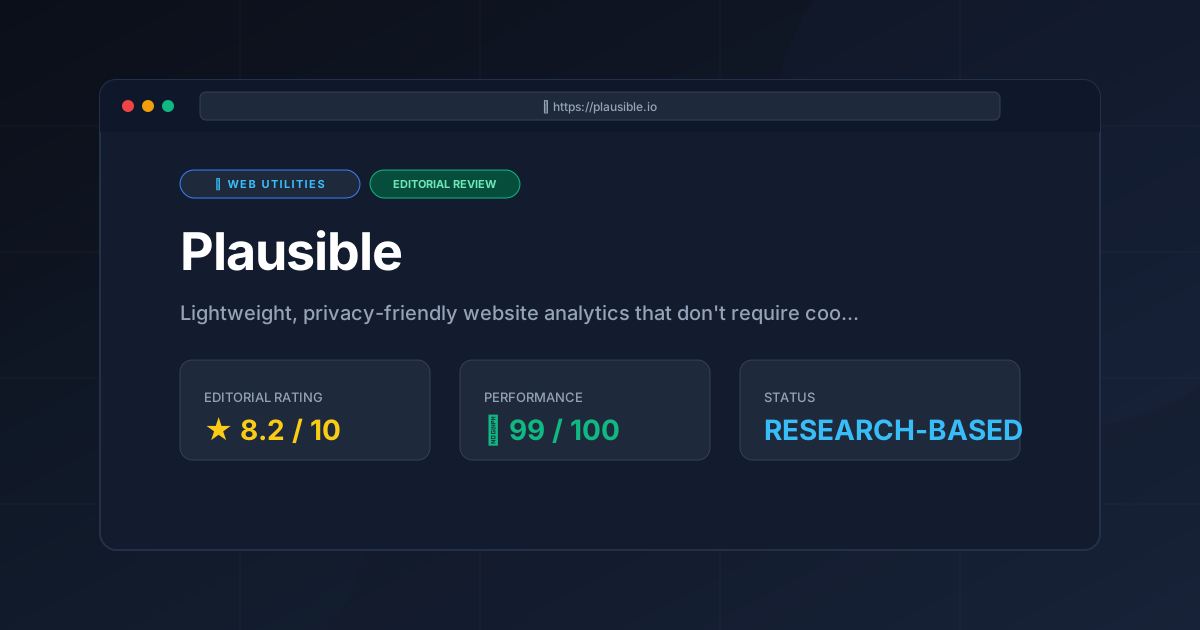
Editorial Rating: 8.2/10 #
A powerful, ethical alternative to big-tech analytics. While the lack of a free cloud tier and limited advanced reporting prevent a perfect score, its impact on site performance and legal compliance is undeniable.
More Tools Worth Reading
Valibot
Web UtilitiesLightweight validation is key to performance. Discover how Valibot reduces bundle sizes and improves TTI—read our full 2026 technical analysis.

Webhook.site
Web UtilitiesWebhook tester tools like Webhook.site simplify API debugging. Learn how to inspect payloads and mock responses to accelerate your development workflo...

WebPageTest
Web UtilitiesPage speed test analysis made easy. Discover how WebPageTest provides forensic performance data to boost your Core Web Vitals and search rankings.