Edge Framework Review: Is Hono the Best Choice for 2026?
⚡ Executive Summary
Edge framework Hono analyzed. Discover how this ultra-fast, runtime-agnostic tool optimizes cold starts and DX to boost your API performance.
Disclaimer: This review is based on publicly available information, including official documentation, the public GitHub repository, and pricing pages; it is not based on internal laboratory benchmarks.
Overview: What is Hono and Why is it Trending? #
In the evolving landscape of JavaScript runtimes, the industry has shifted from a monolithic Node.js dominance toward a fragmented, distributed "Edge" architecture. As developers move logic closer to the user via Cloudflare Workers, Vercel Edge Functions, and Deno Deploy, the overhead of traditional frameworks has become a liability. This is where the edge framework known as Hono enters the conversation.
What is an Edge Framework? #
An edge framework is a lightweight web development library optimized for distributed runtimes (like Cloudflare Workers or Bun) rather than traditional centralized servers. It prioritizes minimal bundle sizes, zero dependencies, and adherence to Web Standard APIs to eliminate cold starts and reduce latency for global users.
The reason Hono is trending in 2026 is its "runtime agnostic" nature. It doesn't lock you into a specific environment. Whether you are deploying to Bun, Deno, Node.js, or a proprietary edge runtime, Hono provides a consistent API. By leveraging the standard Web Fetch API, it bypasses the need for heavy polyfills, making it one of the most efficient ways to build APIs in the modern era. You can explore the full capabilities on the official Hono website.
Key Technical Specifications & Fast Facts #
| Specification | Detail |
|---|---|
| License | MIT License (Open Source) |
| Hosting Type | Runtime Agnostic (Edge, Serverless, Node) |
| Free Tier Availability | N/A (Software is free/Open Source) |
| API Access | Full programmatic access via TypeScript/JS |
| Supported Platforms | Cloudflare Workers, Fastly Compute, Deno, Bun, Node.js, AWS Lambda |
| Core Architecture | RegExp Router / Web Standard API |
In-Depth Feature Breakdown & Real-World Use Cases #
1. Zero-Dependency Architecture #
Most modern frameworks bring a "dependency tree" that can bloat a project before a single line of business logic is written. Hono is built with zero dependencies. This is not just a vanity metric; in a serverless environment, every kilobyte added to the deployment package can marginally increase the cold start time.
Practical Workflow:
When deploying a simple health-check endpoint or a webhook receiver on Cloudflare Workers, Hono allows the developer to maintain a tiny footprint. This makes it an ideal companion for those following a JS Runtime Review: Is Bun the Fastest Choice for 2026? strategy, as it complements Bun's native speed with a lightweight routing layer.
2. TypeScript-First Development (Type Safety) #
Hono is written in TypeScript and provides first-class support for it. One of its most powerful features is the ability to share types between the server and the client. Through the use of hono/client, developers can achieve end-to-end type safety without needing a heavy schema registry or a separate API definition file.
Example Use Case:
Imagine building a backend for a high-performance dashboard. By exporting the AppType from the Hono server, the frontend can use a typed client to call endpoints. If a developer changes a route parameter from a string to a number on the server, the frontend build will fail immediately, preventing runtime errors in production.
3. Edge-First Routing (RegExp Router) #
The core of Hono's speed lies in its router. It utilizes a highly optimized routing algorithm that handles complex path parameters and wildcards with minimal overhead. While Express uses a linear search through middleware, Hono's router is designed to resolve paths with extreme efficiency, which is critical when handling thousands of requests per second at the edge.
Practical Application:
For developers building a multi-tenant SaaS where URLs follow a pattern like api.example.com/:tenantId/v1/resource, Hono’s router ensures that the :tenantId is parsed and injected into the context without adding significant latency to the request lifecycle.
4. Middleware Ecosystem #
Despite its small size, Hono provides a robust set of built-in middleware for common tasks: CORS, Basic Auth, JWT validation, and Logger. Because it adheres to the Web Standard Request/Response objects, these middlewares are portable across different runtimes.
Step-by-Step Getting Started Guide #
Getting Hono up and running is streamlined to minimize "configuration fatigue."
Step 1: Initialize the Project
The fastest way to start is using the npm create hono command. This interactive CLI allows you to choose your target environment (e.g., Cloudflare Workers, Bun, or Node.js).
npm create hono@latest my-appStep 2: Define Your Routes
Once the project is initialized, you can define your application logic in the main entry file.
import { Hono } from 'hono'
const app = new Hono()

app.get('/', (c) => c.text('Hono is running!'))
app.get('/api/user/:id', (c) => {
  const id = c.req.param('id')
  return c.json({ userId: id, status: 'active' })
})

export default app
Step 3: Local Development
Depending on your chosen runtime, you will run the development server. For example, if using Bun:
bun run devStep 4: Deployment
If you are targeting Cloudflare Workers, you would use the wrangler CLI to deploy:
npm run deployObjective Pros & Cons Matrix #
| Pros | Cons |
|---|---|
| Extreme Performance: Minimal overhead and fast routing make it ideal for low-latency apps. | Smaller Ecosystem: Lacks the massive library of third-party plugins available to Express. |
| Runtime Agnostic: Write once, deploy to Bun, Deno, Node, or Edge. | Web API Learning Curve: Developers used to Node-specific APIs (like req.body as a stream) must adapt. |
| Superior DX: Built-in TypeScript support and a clean, intuitive API. | Limited Monolith Features: Not intended for complex, monolithic SSR apps. |
| Tiny Bundle Size: Significantly reduces cold starts in serverless environments. | Documentation Gaps: Advanced edge-case integrations often require searching GitHub Issues. |
Hono vs. Other Edge Framework Options #
When comparing Hono to other options, the primary trade-off is between "batteries-included" and "minimalist."
| Feature | Hono | Express | Fastify |
|---|---|---|---|
| Primary Focus | Edge/Serverless | General Purpose Node | High-Performance Node |
| Speed | Ultra-Fast (Edge Optimized) | Moderate | Fast |
| TypeScript | Native/First-class | Via @types/express |
Strong Support |
| Dependencies | Zero | Numerous | Moderate |
| Pricing | Open Source | Open Source | Open Source |
| Best For | Cloudflare Workers, Bun | Legacy Apps, Simple Node APIs | High-throughput Node servers |
Technical Limitations and Trade-offs #
While Hono is powerful, it is not a universal solution. There are four concrete limitations that architects must consider:
- Lack of Native State Management: Hono is designed to be stateless. If your application requires complex in-memory session management across multiple edge nodes, you cannot rely on the framework. You must integrate an external store like Redis or a Supabase Review (2026): The Best Backend as a Service for PostgreSQL instance.
- Web Standard Constraints: By adhering strictly to the Web Fetch API, Hono cannot use Node.js-specific modules (like
fsorchild_process) unless you are running specifically in a Node environment with polyfills. This limits its use for system-level tooling. - Middleware Maturity: While the built-in middleware is excellent, the community-driven middleware ecosystem is a fraction of the size of Express. You will likely find yourself writing custom middleware for niche requirements.
- Limited SSR Tooling: While Hono has
hono/jsx, it is not a full-featured meta-framework like Next.js or Nuxt. It is an API-first tool. If your primary goal is a complex, SEO-heavy monolithic website, Hono is better suited as the API layer for a frontend built via Bolt.new Review (2026): Features, Pricing & Verdict.
Pricing Tiers & Value Assessment #
Hono is Open Source (MIT License). There are no "Pro" or "Enterprise" tiers for the framework itself. This makes the value proposition incredibly high, as there is no financial barrier to entry or scaling.
However, it is important to distinguish between the framework (Hono) and the hosting. While Hono is free, the platforms you deploy it on (like Cloudflare Workers or AWS Lambda) have their own pricing models. You can review the specific costs on the Cloudflare Workers Pricing page.
Frequently Asked Questions #
Can I migrate an existing Express app to Hono? #
Yes, but it is not a "drop-in" replacement. While the routing syntax is very similar (app.get, app.post), Hono uses the Web Standard Request and Response objects rather than the Node.js req and res objects. You will need to update how you handle headers and body parsing.
Does Hono support WebSockets? #
Hono is primarily designed for request-response cycles. While some runtimes (like Bun or Node) support WebSockets, Hono's core focus is on the HTTP layer. For real-time bidirectional communication, you would typically handle the WebSocket upgrade at the runtime level or use a dedicated service.
Is Hono suitable for large-scale monolithic applications? #
Hono is optimized for microservices and edge functions. While you can build a large app with it, you won't find the built-in "batteries-included" features of a framework like NestJS. If you are building a massive enterprise monolith, you might find yourself manually implementing many architectural patterns.
How does Hono handle middleware compared to Fastify? #
Fastify uses a sophisticated plugin system and a lifecycle hook approach. Hono uses a more traditional middleware chain (similar to Express) but optimizes it for the edge. It is simpler to set up but offers slightly less granular control over the internal request lifecycle than Fastify's hook system.
Does Hono work with AWS Lambda? #
Yes, Hono is runtime agnostic. By using the appropriate adapter, you can deploy Hono applications to AWS Lambda, though the "edge" benefits are most pronounced when using AWS Lambda@Edge or Cloudflare Workers.
Final Verdict & Editorial Rating #
Hono represents a paradigm shift in how we think about JavaScript backends. It acknowledges that the "server" is no longer a single machine in a data center, but a distributed network of edge nodes. By stripping away the legacy baggage of Node.js and embracing Web Standards, Hono provides a developer experience that is both fast and future-proof.
It is not a replacement for every project—if you are building a traditional, heavy-duty Node.js application with deep dependencies on the Node ecosystem, Fastify or Express may still be the safer bet. However, for anyone building on the edge, using Bun, or creating high-performance APIs, Hono is currently the gold standard.
Who should use Hono?
- Developers deploying to Cloudflare Workers, Vercel Edge, or Deno.
- Teams using Bun who want a lightweight routing layer.
- Developers who prioritize TypeScript type safety and minimal cold starts.
- Architects building a decoupled frontend and needing a lightning-fast API backend.
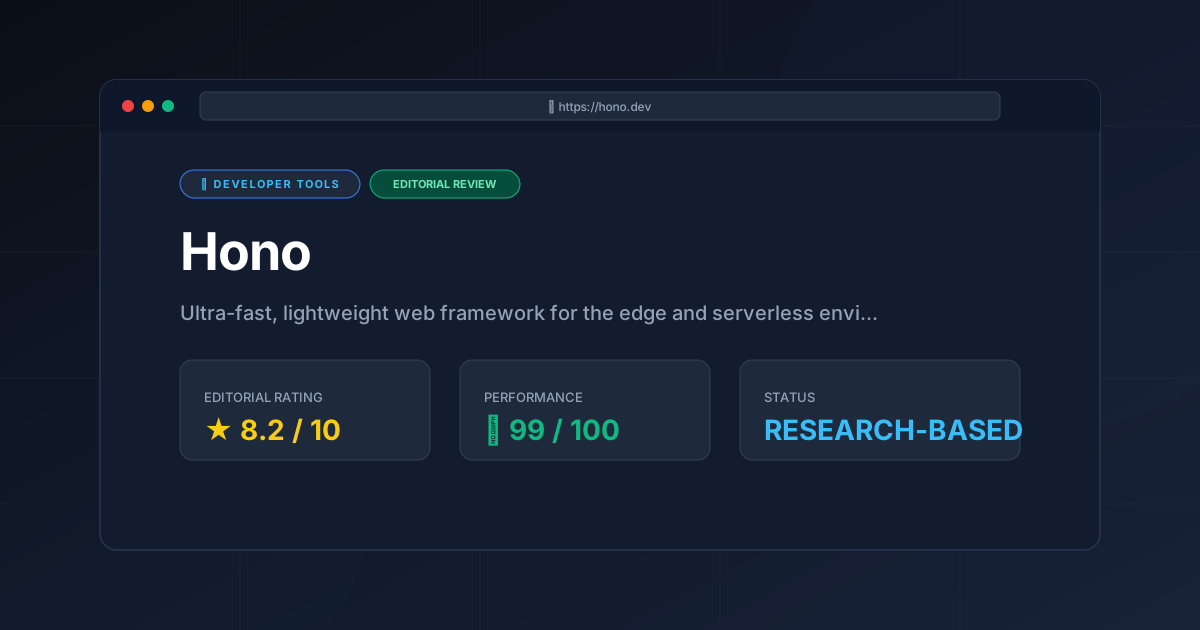
Editorial Rating: 8.2/10 #
A masterclass in efficiency and modern API design. It loses points due to a smaller third-party ecosystem and the inherent limitations of the Web Standard API compared to the full Node.js runtime, but for the modern edge-stack, it is nearly peerless.
More Tools Worth Reading
Supabase
Developer ToolsOpen source firebase alternatives are evolving. Discover if Supabase is the right backend for your 2026 project with our deep technical analysis.
Supabase Edge Functions
Developer ToolsSupabase Edge Functions review: Explore the Deno-powered serverless architecture, pricing, and limitations to accelerate your global app deployment.
Supabase
Developer ToolsBackend-as-a-Service redefined. Explore our deep dive into Supabase 2026 to see if this open-source powerhouse is the right choice for your next proje...