Serverless Snippets: Val Town Review (2026) & Verdict
⚡ Executive Summary
Serverless snippets made easy. Discover if Val Town is the best platform for instant JS deployment and social coding. Read our full technical review.
Disclaimer: This review is based on publicly available information, including official documentation, pricing pages, and public repositories; it is not a laboratory benchmark.
In the modern developer ecosystem, the friction between "writing a quick script" and "deploying a cloud function" has historically been significant. Even with the rise of serverless providers, the overhead of configuring IAM roles, setting up CI/CD pipelines, or managing environment variables often outweighs the utility of a 10-line JavaScript function. This is where the concept of serverless snippets becomes transformative.
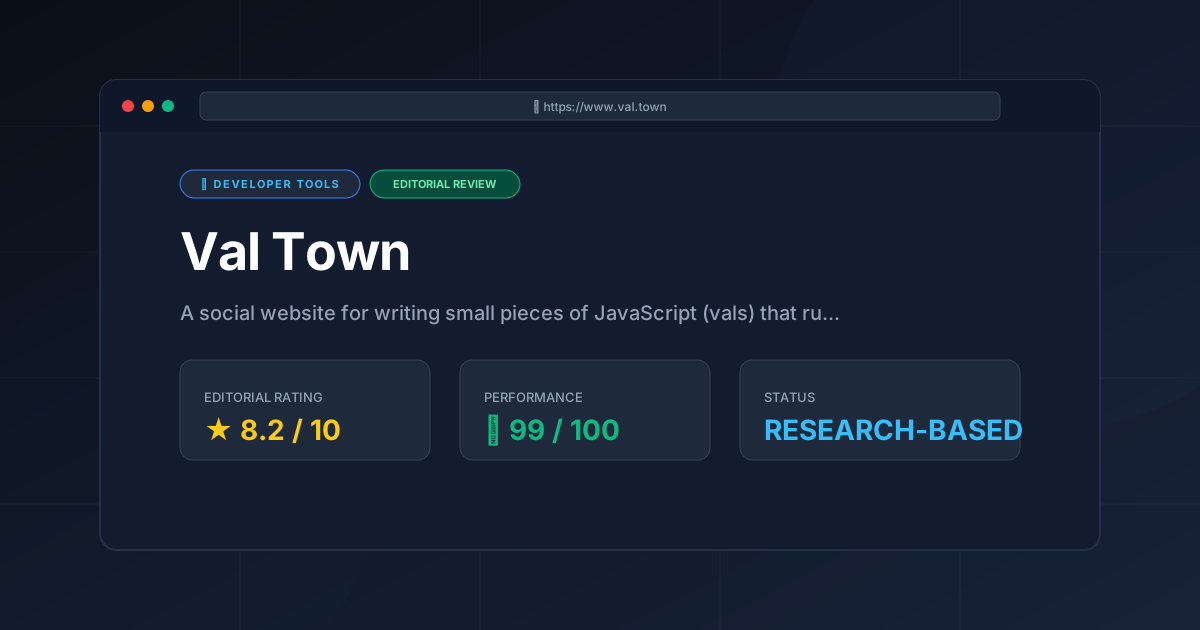
Val Town positions itself not as a full-scale cloud infrastructure provider, but as a "social website for writing small pieces of JavaScript." It treats code as a first-class citizen of the web, blending the immediacy of a REPL with the persistence of a cloud host and the community aspect of a social network. By removing the "deployment" phase entirely, it allows developers to move from ideation to execution in seconds.
What are Serverless Snippets in Val Town? #
Serverless snippets in Val Town are small, independent JavaScript or TypeScript functions called "vals" that are hosted and executed in the cloud instantly. Unlike traditional serverless platforms, these snippets require no local environment or CLI; saving the code in the browser-based IDE automatically deploys it as a live, scalable endpoint.
Overview: Why Val Town is Trending in 2026 #
Val Town is trending because it taps into the "micro-tooling" movement. Developers are increasingly looking for ways to automate small tasks—such as sending a daily Slack notification, scraping a specific webpage, or creating a webhook for a GitHub action—without the cognitive load of managing a full repository.
By adding a social layer, Val Town allows users to discover, fork, and iterate on other developers' work, effectively creating a living library of serverless snippets. This community-driven approach reduces the "boilerplate fatigue" that often plagues modern web development.
Key Technical Specifications & Fast Facts #
| Specification | Detail |
|---|---|
| License | Proprietary (SaaS) |
| Hosting Type | Managed Serverless (Cloud) |
| Free Tier Availability | Yes |
| API Access | Built-in HTTP endpoints for every val |
| Supported Platforms | Web-based (Browser) |
| Primary Language | JavaScript / TypeScript |
| Official Documentation | Val Town Docs |
In-Depth Feature Breakdown & Real-World Use Cases #
To understand the utility of Val Town, one must look past the "social" aspect and analyze the technical primitives it provides.
1. Instant HTTP Endpoints #
Every val created in Val Town can be configured as an HTTP endpoint. The moment you write a function and hit save, you have a live URL that can receive GET and POST requests.
Practical Workflow:
Imagine you need a simple webhook to receive data from a third-party service like Stripe or Shopify. Instead of setting up a Node.js server, you create a val that exports a default function receiving a request object. You can then immediately point your webhook URL to the Val Town endpoint. This eliminates the "local-to-cloud" deployment gap entirely.
2. Scheduled Execution (Cron Jobs) #
Val Town allows vals to be triggered on a schedule. This transforms a simple snippet into a persistent background worker.
Practical Workflow:
A developer could write a val that fetches the latest industry news via an API and posts a summary to a Discord channel every morning at 8:00 AM. Because the environment is managed, there is no need to manage a VPS or a complex cron configuration on a Linux server. For those building more complex agentic workflows, this capability mirrors some of the scheduling logic found in our Agent Native Review (2026): Best Framework for Agentic Apps?, albeit at a much smaller, snippet-based scale.
3. Social Coding and Forking #
The "Social" part of Val Town is its most distinct differentiator. Users can make their vals public, allowing others to see the implementation and "fork" it into their own account.
Practical Workflow:
If a developer finds a complex val that handles OAuth2 authentication for a specific API, they don't have to copy-paste the code and manually fix dependencies. They can fork the val, update the API keys in their own environment variables, and have a working implementation in seconds. This creates a community-driven ecosystem of "lego bricks" for the web.
4. Integrated Environment Variables #
Managing secrets is often the most tedious part of serverless deployment. Val Town integrates secret management directly into the editor, allowing developers to store API keys and tokens securely without hardcoding them into the script.
Technical Implementation: Step-by-Step Guide #
Getting started with Val Town is designed to be near-instantaneous. Follow these steps to deploy your first function.
Step 1: Account Setup #
Visit val.town and sign up. The onboarding process is streamlined to get you into the editor as quickly as possible.
Step 2: Creating Your First Val #
Click the "New Val" button. You will be presented with a code editor that supports TypeScript out of the box.
Step 3: Writing the Logic #
Write a simple JavaScript function. For a basic HTTP response, use the following pattern:
export default async function(req) {
  return new Response("Hello from Val Town!");
}
Step 4: Deployment and Testing #
Simply save the val. Your code is now live. Val Town provides a unique URL for your val. Copy this URL into your browser or a tool like Postman to see your function execute in real-time.
Step 5: Advanced Configuration #
To add a schedule, use the built-in cron interface to define when the val should run. To add secrets, use the vals.SECRET_NAME syntax to pull encrypted variables from your account settings.
Objective Pros & Cons Matrix #
| Pros | Cons |
|---|---|
Zero Configuration: No package.json, no Dockerfiles, no YAML configs. |
Language Lock-in: Primarily focused on JavaScript/TypeScript; not suitable for Python or Go. |
| Instant Feedback Loop: The time from "idea" to "live URL" is measured in seconds. | Limited Scale: Not designed for high-throughput enterprise applications or heavy compute. |
| Community Knowledge: The ability to fork proven snippets reduces boilerplate work. | Vendor Lock-in: Moving a large collection of vals requires manual migration. |
| Built-in Tooling: Integrated HTTP handling and scheduling without external dependencies. | Browser Dependency: The primary development experience is tied to the web IDE. |
Val Town vs. Competitors: Direct Comparison #
When comparing Val Town to industry giants like AWS Lambda or Google Cloud Functions, it is important to realize they serve different purposes. AWS and GCP are infrastructure platforms; Val Town is a productivity platform.
| Feature | Val Town | AWS Lambda | Google Cloud Functions |
|---|---|---|---|
| Setup Time | Seconds | Minutes/Hours | Minutes/Hours |
| Deployment | Auto-save | CLI / CI-CD Pipeline | CLI / Console / Git |
| Developer Experience | Social / Browser-based | Industrial / Console-based | Industrial / Console-based |
| Pricing | Freemium (Simple) | Pay-as-you-go (Complex) | Pay-as-you-go (Complex) |
| Scalability | Low to Medium | Extremely High | Extremely High |
| Best For | Snippets, Webhooks, Prototypes | Enterprise Backends, Big Data | GCP Ecosystem Integration |
For developers who find the complexity of AWS overwhelming and are looking for a "Backend-as-a-Service" feel for small scripts, Val Town is a strong alternative. However, for full-scale database management and complex relational schemas, a dedicated tool like those discussed in our Supabase Review (2026): The Best Backend as a Service for remains the professional standard. If you are prioritizing code quality and linting for larger projects, you might also consider the tools mentioned in our Fast Linter Review: Is Biome the Best Choice for 2026?.
Pricing Tiers & Value Assessment #
Val Town operates on a Freemium model. Detailed pricing can be found on their official pricing page.
- Free Tier: Designed for hobbyists and those experimenting with serverless snippets. It provides ample room for personal automation and small-scale webhooks.
- Paid Tier: Offers increased limits on execution time, more generous resource allocations, and advanced features for those using Val Town for production-lite tasks.
Is the paid tier worth it?
For the vast majority of users, the free tier is sufficient because the "vals" are intended to be small. The paid tier becomes valuable only when your snippets transition from "personal utility" to "small business infrastructure," where reliability and higher execution limits become critical.
Frequently Asked Questions #
Is Val Town a replacement for a full backend? #
No. Val Town is designed for small pieces of JavaScript. While you can build impressive things, it lacks the integrated database management and complex state handling of a full backend framework. It is a complement to your stack, not a replacement for a primary server.
How secure are the environment variables in Val Town? #
Val Town provides a dedicated secrets management system to ensure that API keys are not exposed in the public code of a val. However, security depends on the user not accidentally logging secrets to the console or exposing them via the HTTP response.
Can I export my vals to my own server? #
Since vals are essentially JavaScript functions, the logic is portable. However, because Val Town provides the runtime, the HTTP wrapper, and the scheduler, you would need to rewrite the "plumbing" using Express.js or a similar framework to run them on your own VPS.
Does Val Town support TypeScript? #
Yes, Val Town has strong support for TypeScript. This allows for better type safety and autocompletion within the browser-based editor, which significantly improves the developer experience for larger snippets and reduces runtime errors.
What are the execution limits for free users? #
Free users have generous limits for small scripts, but there are caps on execution time and memory. For high-frequency tasks or long-running processes, the paid tier is necessary to avoid timeouts and ensure consistent availability.
Final Verdict & Editorial Rating #
Val Town is a masterclass in reducing developer friction. By treating the cloud as a social sketchbook rather than a daunting data center, it empowers developers to ship small ideas instantly. It is not a tool for building the next Netflix, but it is the perfect tool for building the "glue" that holds the modern web together.
The primary trade-off is the sacrifice of industrial-scale control for extreme velocity. For those who spend too much time configuring their environment and not enough time writing logic, Val Town is a revelation.
Who should use it? #
- Indie Hackers: For rapid prototyping and building MVP webhooks.
- DevOps Engineers: For creating quick internal automation scripts.
- Learners: For experimenting with JavaScript in a live cloud environment without setup hurdles.
- Power Users: For automating personal life/work via scheduled scripts.
Who should avoid it? #
- Enterprise Architects: Who require strict VPC isolation and complex compliance certifications.
- Heavy Compute Users: Those running long-process data analysis or ML models.
Editorial Rating: 8.2/10
A highly focused, brilliantly executed tool that solves a specific problem: the overhead of the "small script."
More Tools Worth Reading
Supabase
Developer ToolsOpen source firebase alternatives are evolving. Discover if Supabase is the right backend for your 2026 project with our deep technical analysis.
Supabase Edge Functions
Developer ToolsSupabase Edge Functions review: Explore the Deno-powered serverless architecture, pricing, and limitations to accelerate your global app deployment.
Supabase
Developer ToolsBackend-as-a-Service redefined. Explore our deep dive into Supabase 2026 to see if this open-source powerhouse is the right choice for your next proje...