Serverless Redis Review (2026): Is Upstash the Best Choice?
⚡ Executive Summary
Serverless redis is the backbone of edge computing. Discover if Upstash is the right fit for your stack with our deep technical dive and 2026 verdict.
Disclaimer: This review is based on publicly available information, including official documentation, pricing pages, and public repositories; it is not based on internal laboratory benchmarks.
As the architectural shift toward "the edge" accelerates, the bottleneck for modern applications has shifted from compute to data. Traditional database connections—which rely on persistent TCP sockets—are fundamentally incompatible with the ephemeral nature of Serverless Functions and Edge Runtimes. This is the gap Upstash aims to fill by providing a robust serverless redis implementation that eliminates the need for connection pooling and infrastructure management.
What is Serverless Redis? #
Serverless redis is a managed version of the Redis data store that abstracts away server provisioning, scaling, and maintenance. Unlike traditional Redis, it uses a pay-per-request pricing model and often provides an HTTP-based API, allowing ephemeral compute environments like AWS Lambda or Cloudflare Workers to access data without maintaining persistent TCP connections.
Overview: Why Upstash is Trending in 2026 #
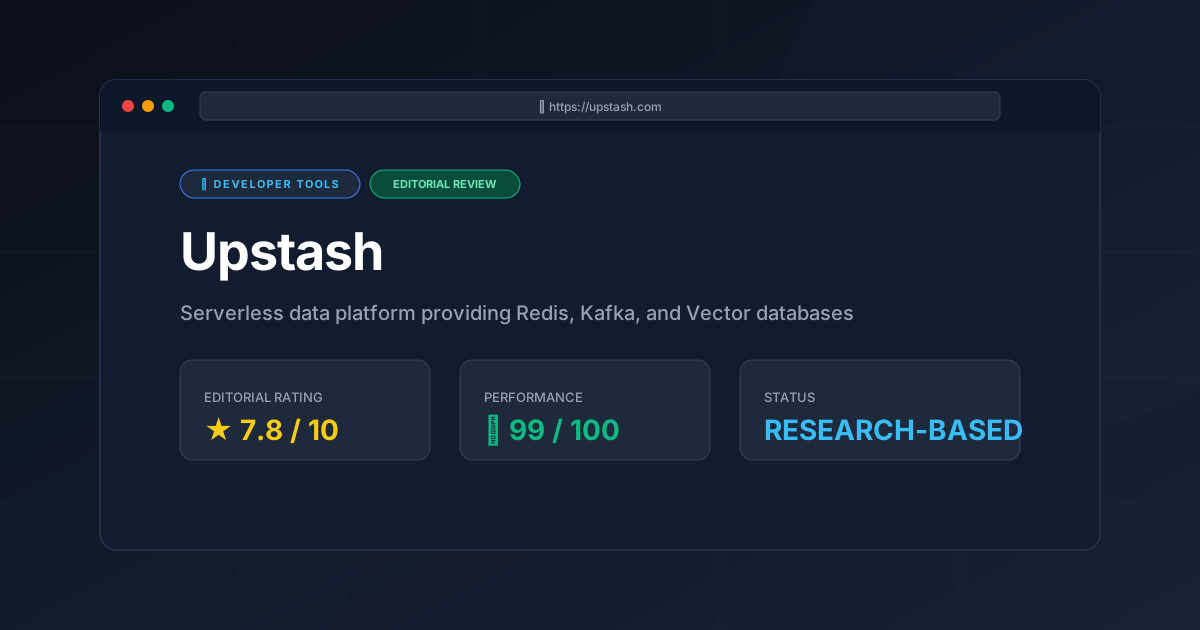
Upstash is a serverless data platform that provides managed Redis, Kafka, and Vector databases. Unlike traditional managed database providers that charge for provisioned instances (CPU/RAM), Upstash operates on a serverless model. This means developers pay for the requests they make rather than the infrastructure they reserve.
The tool is trending primarily because of the rise of "Edge Computing." When deploying code to platforms like Vercel, Netlify, or Cloudflare Workers, developers cannot maintain a long-lived connection to a standard Redis instance without risking connection exhaustion or high latency. Upstash solves this by offering an HTTP-based API, allowing serverless functions to interact with data via standard REST calls, effectively bypassing the TCP connection overhead.
Key Technical Specifications & Fast Facts #
| Specification | Detail |
|---|---|
| License | Proprietary (Managed Service) |
| Hosting Type | Fully Managed Serverless |
| Free Tier Availability | Yes (Request-based limits) |
| API Access | REST API & Standard Client Libraries |
| Supported Platforms | AWS, GCP, Azure, Vercel, Cloudflare Workers, Netlify |
| Official Documentation | Upstash Docs |
| Pricing Model | Pay-as-you-go |
In-Depth Feature Breakdown & Real-World Use Cases #
Upstash is not a single tool but a suite of three distinct serverless offerings. Each addresses a specific architectural need in the modern stack.
1. Serverless Redis #
The flagship product is a Redis-compatible database that allows for caching, session management, and rate limiting without the need to manage clusters.
Technical Analysis: The core innovation here is the dual-protocol support. While it supports the standard Redis protocol (RESP), it provides a robust HTTP API. This is critical for environments where TCP is restricted or inefficient. For developers building high-performance backends, pairing this with a fast runtime—such as those discussed in our JS Runtime Review: Is Bun the Fastest Choice for 2026?—can significantly reduce the "cold start" impact on data retrieval.
Use Case: Global Rate Limiting
Imagine a public API that needs to limit users to 100 requests per minute. In a serverless environment, you cannot store this count in local memory because each request may hit a different lambda function.
- Workflow: The Edge Function sends a
POSTrequest to the Upstash REST API $\rightarrow$ Upstash increments the key usingINCR$\rightarrow$ The function receives the current count and decides whether to allow the request.
2. Upstash Vector #
With the explosion of LLMs and RAG (Retrieval-Augmented Generation), the need for vector databases has skyrocketed. Upstash Vector provides a serverless way to store and query embeddings.
Technical Analysis: Upstash Vector focuses on simplicity. It allows developers to store vectors and perform cosine similarity searches via an API. This eliminates the need to manage complex indexing clusters. For those building AI-driven applications, this serves as a lightweight alternative to full-scale backend infrastructures like those found in our Supabase Review (2026): The Best Backend as a Service for.
Use Case: Semantic Search for Documentation
- Workflow: Convert documentation paragraphs into vectors using an embedding model $\rightarrow$ Store them in Upstash Vector $\rightarrow$ When a user asks a question, vectorize the query $\rightarrow$ Perform a similarity search in Upstash to retrieve the most relevant context for the LLM.
3. Serverless Kafka #
Kafka is traditionally notorious for its operational complexity. Upstash abstracts this, providing a serverless messaging queue for event-driven architectures.
Technical Analysis: By offering Kafka as a service, Upstash allows developers to implement asynchronous processing (e.g., sending emails, processing images) without managing Zookeeper or broker nodes. It follows the same per-request pricing model, making it viable for small projects that would otherwise be priced out of Kafka.
Use Case: Event-Driven Microservices
- Workflow: A user signs up $\rightarrow$ The frontend triggers a "UserCreated" event to Upstash Kafka $\rightarrow$ Multiple downstream services (Welcome Email Service, Analytics Service, CRM Sync) consume this event independently.
Step-by-Step Getting Started Guide #
Integrating a serverless redis instance into a project is designed to be a "five-minute" process.
Configuration Checklist #
- [ ] Create account at
upstash.com. - [ ] Select the region closest to your compute (e.g.,
us-east-1for AWS Lambda) to minimize latency. - [ ] Copy the
UPSTASH_REDIS_REST_URLandUPSTASH_REDIS_REST_TOKEN. - [ ] Install the client library:
npm install @upstash/redis.
Implementation Example #
import { Redis } from "@upstash/redis"

// Initialize the client with environment variables
const redis = new Redis({
  url: process.env.UPSTASH_REDIS_REST_URL,
  token: process.env.UPSTASH_REDIS_REST_TOKEN,
})

async function handleRequest(userId) {
  // Set a value with an expiration (TTL) of 3600 seconds
  await redis.set(`session:${userId}`, { active: true }, { ex: 3600 })

  // Retrieve the value
  const session = await redis.get(`session:${userId}`)
  return session
}
Critical Limitations and Trade-offs #
While Upstash simplifies the developer experience, it introduces specific technical trade-offs that architects must consider.
- HTTP Protocol Overhead: While the REST API is essential for serverless functions, it is inherently slower than raw TCP for high-frequency operations. In a traditional monolithic environment, the overhead of HTTP headers and handshakes can lead to higher latency compared to a persistent RESP connection.
- Cost Inefficiency at Extreme Scale: The pay-per-request model is a boon for startups, but it becomes a liability for high-throughput applications. If your application maintains a constant load of 10,000+ requests per second, the cumulative cost of serverless requests will significantly exceed the monthly cost of a provisioned EC2 instance running self-hosted Redis.
- Limited Configuration Depth: Users cannot access the
redis.conffile. Advanced tuning—such as modifying the eviction policy at a granular level or adjusting memory fragmentation settings—is unavailable. You are bound by the platform's global defaults. - Vendor Lock-in via REST API: While the data is Redis-compatible, the specific SDKs and REST patterns used to integrate Upstash create a dependency. Migrating to a standard Redis instance requires rewriting the data access layer to move from HTTP calls back to TCP sockets.
Upstash vs. Competitors: Direct Comparison #
| Feature | Upstash | Redis Cloud | Pinecone |
|---|---|---|---|
| Primary Focus | Serverless Multi-tool | Managed Redis | Pure Vector DB |
| Connection | REST + RESP | Primarily RESP (TCP) | gRPC / HTTP |
| Pricing Model | Per-request | Provisioned/Tiered | Pod-based/Serverless |
| Edge Support | Native/Excellent | Moderate | Good |
| Best For | Serverless/Edge Apps | Enterprise Legacy Apps | Large-scale AI Search |
Pricing Tiers & Value Assessment #
Upstash utilizes a Freemium model. The free tier is generous for developers, typically offering a set number of requests per day for free, which is sufficient for hobby projects or early-stage MVPs.
The Paid Tier (Pay-as-you-go):
The transition to the paid tier is seamless. Instead of jumping to a $50/month plan, you pay for what you use. This is an immense value proposition for startups.
Is it worth it?
For 90% of serverless developers, yes. The cost of the "developer time" saved by not managing a Redis cluster far outweighs the per-request cost. However, if your application performs thousands of operations per second consistently 24/7, the per-request cost will eventually exceed the cost of a reserved instance on Redis Cloud or a self-hosted solution.
Frequently Asked Questions #
Is Upstash a full replacement for Redis? #
It is a managed implementation of Redis. While it supports the vast majority of Redis commands, some highly specialized modules or deep configuration settings available in a self-hosted Redis instance are not available. It is designed for agility over total control.
How does the HTTP API affect performance? #
For traditional servers, it adds a small amount of overhead. However, for serverless functions, it is actually faster because it avoids the "TCP Handshake" penalty that occurs every time a serverless function wakes up from a cold start.
Can I migrate my data out of Upstash? #
Yes, since it is Redis-compatible, you can use standard Redis export tools or the MIGRATE command to move data to another Redis-compatible instance. This mitigates the risk of total data lock-in.
Does Upstash Vector support metadata filtering? #
Yes, it allows you to attach metadata to your vectors and filter queries based on those attributes. This is essential for building production-grade RAG applications where you need to filter results by user ID or date.
How does serverless redis handle scaling? #
Scaling is automatic. Because the infrastructure is abstracted, Upstash handles the underlying resource allocation as your request volume increases. You do not need to manually resize clusters or add shards.
Final Verdict & Editorial Rating #
Upstash is a masterclass in "Developer Experience" (DX). By identifying the specific pain point of serverless connectivity and solving it with an HTTP-first approach, they have made high-performance data storage accessible to the "single-file" developer.
However, the rating is tempered by the inherent cost-scaling issues and the lack of deep configuration options. While it is the gold standard for the modern edge stack, it is not a "one size fits all" solution for every enterprise architecture. If you are building with Vercel, Cloudflare, or any serverless framework, Upstash is the most logical choice for your state management.
Final Score: 7.8/10 #
Who should use it?
- Serverless Developers: Absolute must-have for those using Lambda, Edge Functions, or Vercel.
- AI Startups: Excellent for rapid prototyping of vector search without infrastructure overhead.
- Indie Hackers: The free tier and pay-as-you-go model remove the financial risk of starting a new project.
Who should avoid it?
- High-Throughput Monoliths: If you have a constant, massive stream of data, a provisioned instance will be more cost-effective.
- Strict On-Premise Requirements: As a managed cloud service, it is not suitable for air-gapped or strictly local environments.
More Tools Worth Reading
Supabase
Developer ToolsOpen source firebase alternatives are evolving. Discover if Supabase is the right backend for your 2026 project with our deep technical analysis.
Supabase Edge Functions
Developer ToolsSupabase Edge Functions review: Explore the Deno-powered serverless architecture, pricing, and limitations to accelerate your global app deployment.
Supabase
Developer ToolsBackend-as-a-Service redefined. Explore our deep dive into Supabase 2026 to see if this open-source powerhouse is the right choice for your next proje...