Serverless Queues Review: Is Inngest the Best Choice for 2026?
⚡ Executive Summary
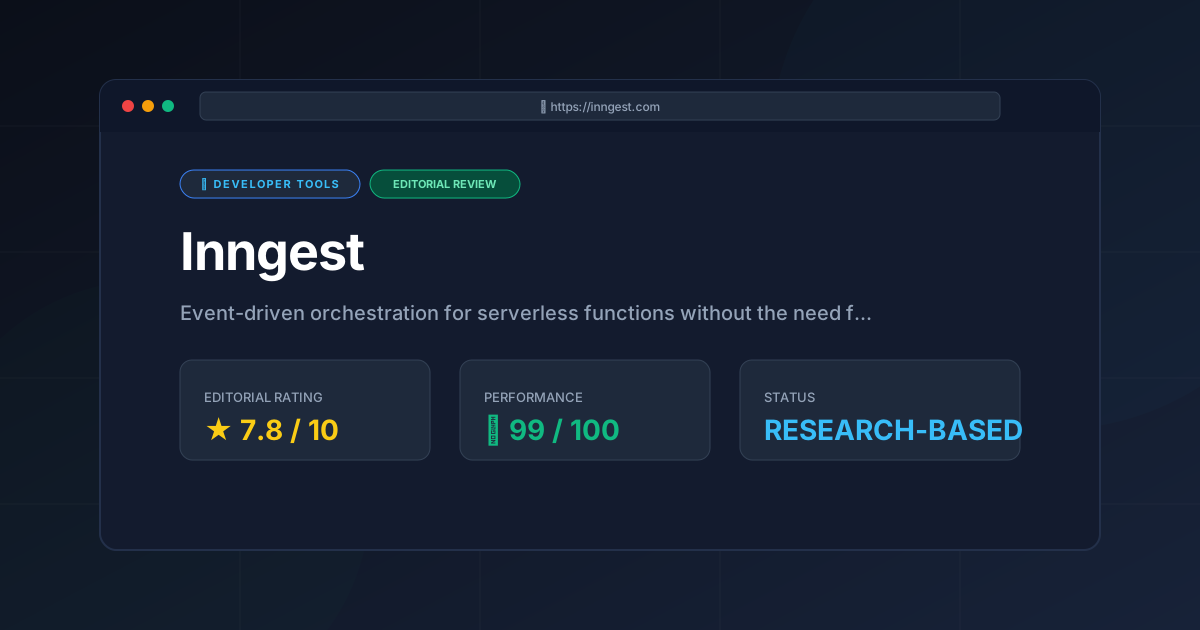
Serverless queues simplified. Discover how Inngest handles event orchestration and durable execution to scale your backend without infrastructure pain.
Disclaimer: This review is based on publicly available information, including official documentation, pricing pages, and public repositories; it is not based on laboratory benchmarks or first-person installation tests.
Overview: What is Inngest and Why is it Trending? #
In the modern cloud landscape, developers face a recurring paradox: while deploying a single function is trivial, managing the flow between those functions is notoriously difficult. Traditional approaches require developers to manually provision and manage message brokers like RabbitMQ or complex serverless queues like AWS SQS. These tools often introduce significant operational overhead, requiring manual scaling and complex dead-letter queue management.
Inngest enters the market as an event-driven orchestration layer that abstracts the infrastructure of queues and brokers away from the developer. Rather than managing a separate piece of infrastructure to handle retries, delays, and state, Inngest allows developers to define "durable functions"—workflows that can sleep for days, wait for specific events, and recover from failures automatically without losing their place in the execution chain.
It is trending because it solves the "distributed monolith" problem. By decoupling the event trigger from the execution logic through a managed cloud layer, it allows teams to build complex, multi-step asynchronous workflows using standard TypeScript or JavaScript code, rather than proprietary JSON-based state machine definitions.
What are Serverless Queues? #
Serverless queues are managed messaging services that allow applications to decouple producers from consumers without provisioning servers. They enable asynchronous processing by holding messages in a buffer until a worker function can process them, automatically scaling based on demand and eliminating the need for manual cluster management or broker maintenance.
Key Technical Specifications & Fast Facts #
| Specification | Detail |
|---|---|
| License | Proprietary (SaaS) |
| Hosting Type | Managed Cloud / Self-hosted (Dev Server) |
| Free Tier Availability | Yes (Freemium) |
| API Access | REST / SDK-based |
| Supported Platforms | Vercel, Netlify, AWS Lambda, Cloudflare Workers, Node.js |
In-Depth Feature Breakdown & Real-World Use Cases #
Inngest is not a simple queue; it is an orchestration engine. To understand its value, we must analyze its three core pillars: Durable Execution, Event-Driven Workflows, and the Local Development Environment.
1. Durable Execution (The "Sleep" and "Wait" Logic) #
In standard serverless functions, a "sleep" command is an anti-pattern because you pay for the execution time while the function does nothing. Inngest implements durable execution, meaning the function state is persisted. When a workflow hits a step.sleep() or step.waitForEvent() command, the function terminates, and Inngest schedules a wake-up call.
Real-World Use Case: User Onboarding Sequence
Imagine a SaaS application where a user signs up. You want to:
- Send a welcome email immediately.
- Wait 3 days.
- Check if the user has completed their profile.
- If not, send a reminder email.
In a traditional setup, this requires a database flag, a cron job, and a complex query. With Inngest, this is a single linear function:
step.run('welcome-email', ...)step.sleep('wait-3-days', '3d')step.run('check-profile', ...)
2. Event-Driven Workflows #
Inngest operates on a "push" model. Your application sends an event to Inngest (e.g., app.user.signed_up), and Inngest triggers the associated functions. This allows for extreme decoupling. Your frontend doesn't need to know which backend services need to react to a signup; it simply emits the event.
For developers building highly integrated backends, this pairs exceptionally well with a robust data layer. For instance, if you are using a Supabase Review (2026): The Best Backend as a Service for architecture, Inngest can act as the glue that triggers complex business logic based on database webhooks.
3. Local Development Environment (The Inngest Dev Server) #
One of the biggest pain points in event-driven architecture is testing. Testing production serverless queues usually requires deploying to a staging environment. Inngest provides a local Dev Server that intercepts events and allows developers to "replay" them. This means you can trigger a failure in a workflow and then re-run the exact same event to see if your fix works, without manually recreating the state in your database.
Real-World Use Case: Payment Failure Recovery
If a Stripe webhook fails due to a 500 error in your code, you can use the Inngest Dev Server to inspect the payload and re-trigger the execution once the bug is patched, ensuring no customer payment is ever "lost" in the void.
Technical Implementation & Configuration #
To implement Inngest, developers must establish a bidirectional communication channel between their application and the Inngest Cloud. Unlike traditional serverless queues that require polling, Inngest uses a webhook-style push mechanism.
Configuration Example (TypeScript) #
import { Inngest } from "inngest";

// 1. Initialize the client
const inngest = new Inngest({ id: "my-app" });

// 2. Define the durable function
export const processOrder = inngest.createFunction(
  { id: "process-order" },
  { event: "shop.order.created" },
  async ({ event, step }) => {
    // Step 1: Immediate action
    await step.run("charge-card", async () => {
      return await stripe.charges.create({ amount: event.data.amount });
    });

    // Step 2: Durable delay (no cost during sleep)
    await step.sleep("wait-for-shipping", "2d");

    // Step 3: Conditional logic based on external event
    await step.waitForEvent("shop.order.shipped", {
      timeout: "7d",
    });
  }
);
Deployment Checklist #
- [ ] Endpoint Exposure: Ensure your
/api/inngestroute is public and reachable by Inngest Cloud. - [ ] Signing Secret: Configure the
INNGEST_SIGNING_KEYin your environment variables to prevent unauthorized event triggers. - [ ] Idempotency: Ensure your
step.runblocks are idempotent, as retries may occur during network instability. - [ ] Timeout Alignment: Match your serverless function timeout (e.g., Vercel's 15s or 30s) with the complexity of your individual steps.
Honest Limitations and Trade-offs #
While Inngest simplifies the developer experience, it is not a silver bullet. There are four concrete limitations that architects must consider:
- Vendor Lock-in (SDK Dependency): Unlike standard AMQP or MQTT protocols used in traditional queues, Inngest logic is written using the Inngest SDK. Migrating away requires rewriting your entire workflow logic, as the "durable" state is managed by their proprietary cloud.
- Increased Latency: Because Inngest acts as a middle-layer orchestrator, every event must travel from your app to Inngest, and then from Inngest back to your app. This introduces a small but measurable overhead compared to direct function-to-function calls.
- Cold Start Amplification: Inngest triggers your functions via HTTP. If you are using a serverless provider with significant cold starts, the "orchestration" can feel sluggish, as each
step.runmay potentially trigger a new cold start depending on how your provider handles concurrency. - Complexity Overhead for Simple Tasks: For basic "fire-and-forget" tasks (e.g., sending a single email), Inngest is overkill. The overhead of setting up the client and endpoint is higher than using a simple native queue or a basic background job library.
Inngest vs. Alternatives: Comparing Serverless Queues #
Inngest occupies a middle ground between the extreme power of Temporal and the rigid structure of AWS Step Functions.
| Feature | Inngest | Temporal | AWS Step Functions |
|---|---|---|---|
| Setup Effort | Low (SDK-based) | High (Requires Cluster) | Medium (JSON/YAML) |
| Execution Model | Event-driven / Serverless | Durable Workflows | State Machine |
| Pricing | Freemium / Usage-based | Open Source / Cloud | Pay-per-transition |
| Developer Experience | High (Code-first) | High (Code-first) | Low (Visual/JSON) |
| Best For | Serverless apps, SaaS | Mission-critical, high-scale | AWS-native enterprises |
While Temporal offers more granular control over state, it requires managing a complex cluster. AWS Step Functions is powerful but often feels like "programming in JSON." Inngest is designed for the developer who wants the power of durable execution without the operational burden. This "developer-first" approach is similar to the philosophy seen in the Bolt.new Review (2026): Features, Pricing & Verdict, where the goal is to reduce the distance between idea and deployment.
Pricing Tiers & Value Assessment #
Inngest utilizes a Freemium model. The free tier is generally generous enough for hobbyists and early-stage startups to build and test their entire orchestration logic. Detailed pricing can be found on the official Inngest pricing page.
Is the paid tier worth it?
For production applications, the paid tier becomes necessary not just for higher event limits, but for the reliability and observability features. The value proposition lies in the "Operational Savings." If you calculate the engineering hours spent managing a RabbitMQ cluster or debugging a failed SQS queue, the cost of Inngest's managed service is often lower than the cost of the developer time required to maintain a DIY alternative.
However, for teams already deeply embedded in the AWS ecosystem who are comfortable with ASL (Amazon States Language), the cost of Step Functions may be more attractive.
Frequently Asked Questions #
Does Inngest replace my database? #
No. Inngest manages the state of the workflow (which step is next, when to wake up), but it does not store your application data. You still use your database (PostgreSQL, MongoDB, etc.) for your primary records.
Can I use Inngest with non-serverless environments? #
Yes. While it is optimized for serverless, you can run the Inngest SDK within a standard Node.js Express server or any environment that can expose an HTTP endpoint.
What happens if my function fails mid-workflow? #
Inngest provides automatic retries with exponential backoff. Because the workflow is durable, it doesn't restart from the beginning; it resumes from the specific step that failed, as detailed in the Inngest Documentation.
Is Inngest compatible with Edge functions? #
Yes. Inngest is designed to work with Edge runtimes (like Cloudflare Workers), provided the runtime supports the necessary HTTP communication.
How does Inngest handle event concurrency? #
Inngest allows you to define concurrency limits per function or per event key. This prevents your downstream services (like a database) from being overwhelmed by a sudden spike in events.
Final Verdict & Editorial Rating #
Inngest is a sophisticated answer to the "distributed state" problem in serverless architecture. It successfully bridges the gap between simple serverless queues and complex workflow engines. By treating the workflow as code rather than a configuration file, it significantly lowers the barrier to entry for building resilient, asynchronous systems.
However, the rating is tempered by the inherent vendor lock-in and the latency overhead introduced by the orchestration layer. For teams with extreme security requirements who cannot allow an external service to trigger their internal endpoints, the dependency may be a dealbreaker.
Who should use it?
- Developers building SaaS platforms with complex onboarding or billing cycles.
- Teams using Vercel, Netlify, or AWS Lambda who are tired of managing SQS/SNS.
- Engineers who need a "reliable" way to handle third-party API webhooks that frequently fail.
Who should avoid it?
- Developers building ultra-low-latency systems where every millisecond of overhead is critical.
- Teams who require total infrastructure ownership and cannot use a SaaS orchestrator.
Editorial Rating: 7.8/10 #
A powerful, developer-centric tool that eliminates the "plumbing" of event-driven architecture, though it introduces significant vendor dependency and minor latency trade-offs.
More Tools Worth Reading
Supabase
Developer ToolsOpen source firebase alternatives are evolving. Discover if Supabase is the right backend for your 2026 project with our deep technical analysis.
Supabase Edge Functions
Developer ToolsSupabase Edge Functions review: Explore the Deno-powered serverless architecture, pricing, and limitations to accelerate your global app deployment.
Supabase
Developer ToolsBackend-as-a-Service redefined. Explore our deep dive into Supabase 2026 to see if this open-source powerhouse is the right choice for your next proje...