Lovable Review (2026): The Best AI App Builder for Rapid MVPs
⚡ Executive Summary
ai app builder Lovable reviewed. Discover how to turn natural language into full-stack apps with GitHub sync to accelerate your 2026 product launch.
Disclaimer: This review is based on publicly available information, including official documentation, pricing pages, and public repositories; it is not based on internal laboratory benchmarks.
The landscape of software development is currently undergoing a seismic shift from "writing code" to "orchestrating intent." At the forefront of this transition is Lovable, a sophisticated ai app builder that positions itself not merely as a code generator, but as an "AI Engineer." Unlike traditional low-code platforms that trap users in proprietary ecosystems, Lovable aims to bridge the gap between natural language descriptions and production-ready, full-stack applications.
What is an AI App Builder? #
An ai app builder is a development platform that leverages large language models (LLMs) to translate natural language prompts into functional software architecture. Unlike simple code assistants, these tools manage the entire application lifecycle—including UI design, state management, and deployment—allowing users to build and iterate on full-stack applications without writing manual boilerplate code.
Overview: Why Lovable is Trending in 2026 #
Lovable is designed to handle the end-to-end lifecycle of application development—building, shipping, and iterating—using natural language. While many AI tools focus on snippets or single-page components, Lovable targets the "full-stack" experience. It allows developers and product managers to describe a complex application idea, which the AI then translates into a functional codebase, manages the deployment, and allows for real-time iterations.
The tool is trending because it addresses the "last mile" problem of AI coding. Many LLMs can write a function, but few can manage the state, routing, database integration, and deployment pipeline of a complete app without significant manual intervention. By integrating high-reasoning models like GPT-4o and providing a seamless bridge to GitHub, Lovable transforms the development workflow from a manual coding process into a conversational design process.
Key Technical Specifications & Fast Facts #
| Specification | Detail |
|---|---|
| License | Proprietary / SaaS |
| Hosting Type | Cloud-based (Managed) |
| Free Tier Availability | Yes (Freemium) |
| API Access | Available via integrated services |
| Supported Platforms | Web-based (Cross-platform) |
| Core AI Engine | GPT-4o Integration |
| Version Control | GitHub Synchronization |
In-Depth Feature Breakdown & Technical Substance #
Lovable distinguishes itself through three core technical pillars: natural language orchestration, instant visual feedback, and professional developer hand-off.
1. Natural Language Full-Stack Orchestration #
Lovable doesn't just generate a static HTML page; it attempts to build the logic, state management, and UI components required for a full application. It utilizes a sophisticated prompt-to-code pipeline that interprets business requirements into a structured file system.
Technical Configuration Example:
Imagine a user wants to build a "Subscription-based SaaS Dashboard for Gym Owners." Instead of writing the boilerplate for React, Tailwind CSS, and a backend, the user prompts: "Build a dashboard where gym owners can track member attendance, manage monthly billing via Stripe, and see a chart of revenue growth over 6 months."
Lovable processes this by:
- Scaffolding: Creating a React-based frontend architecture with a defined folder structure.
- Styling: Implementing a responsive UI using Tailwind CSS utility classes for rapid layout adjustments.
- Logic Implementation: Creating the logic for data visualization using libraries like Recharts or Chart.js.
- Integration Hooks: Setting up the conceptual API endpoints and hooks for payment integration.
2. Instant Preview and Iterative Refinement #
The "Instant Preview" feature is critical for the "no-code to code" transition. As the AI generates the application, the user sees a live version of the app side-by-side with the chat interface. This creates a tight feedback loop that reduces the "hallucination gap" common in standalone LLMs.
Practical Workflow Example:
After the initial build, the user might notice the dashboard is too cluttered. They can simply prompt: "The member list is too long; convert it into a paginated table and add a search bar at the top." Lovable modifies the existing code in real-time, updates the preview, and maintains the application's state, allowing for rapid UI/UX polishing without manual CSS tweaking.
3. GitHub Synchronization and Developer Sovereignty #
One of the biggest fears with any ai app builder is "vendor lock-in." Lovable mitigates this through deep GitHub synchronization. This allows professional developers to move the project from the AI environment into a local IDE.
Technical Trade-offs:
While the AI handles the bulk of the work, there is a trade-off between speed and optimization. AI-generated code is often verbose. For projects requiring extreme performance—perhaps requiring a highly optimized JS Runtime for specific backend tasks—the developer syncs the project to GitHub. They can then clone the repository, perform a manual code review, and implement custom business logic that exceeds the AI's current reasoning capabilities.
Step-by-Step Implementation Guide #
To maximize the utility of Lovable, follow this structured onboarding path:
Phase 1: Environment Setup #
- Account Creation: Visit the official Lovable site and create an account.
- GitHub Integration: Immediately connect your GitHub account. This ensures that every prompt-driven change is committed to a branch, providing a version-controlled safety net.
Phase 2: The Prompting Strategy #
- The Macro Prompt: Begin with a high-level architectural prompt. Describe the overall purpose, the primary users, and the 3-5 core features.
- Bad Prompt: "Make a gym app."
- Good Prompt: "Build a full-stack gym management app for small business owners. Include a member directory, a billing page with Stripe integration, and a dashboard showing monthly churn rates."
- The Micro Prompt (Iterative Sculpting): Use the "one-change-at-a-time" technique. Ask for one specific change (e.g., "Change the primary color to emerald green"), verify it in the Instant Preview, and then move to the next.
Phase 3: Deployment and Scaling #
- Audit: Review the generated code in GitHub to ensure there are no security vulnerabilities in the API routes.
- Shipping: Use the built-in shipping tools to move your app from the preview environment to a live URL.
Objective Pros & Cons Matrix #
| Pros | Cons |
|---|---|
| Rapid Prototyping: Drastically reduces the time from idea to functional MVP. | Prompt Dependency: The quality of the output is heavily dependent on the user's ability to prompt clearly. |
| No Lock-in: GitHub sync allows developers to take full ownership of the code. | Complexity Ceiling: Extremely complex, bespoke enterprise logic may still require manual coding. |
| Integrated Stack: Handles UI, logic, and deployment in one conversational interface. | Token Costs: High-frequency iterations on large apps can exhaust free-tier limits quickly. |
| Low Barrier to Entry: Enables non-technical founders to build functional prototypes. | Review Overhead: Professional developers must still audit AI-generated code for security and efficiency. |
Lovable vs. Alternatives: Choosing the Right AI App Builder #
Lovable operates in a crowded space alongside other "AI-first" development tools. While it shares similarities with Bolt.new, its focus on the "Engineer" persona rather than just a "Generator" persona is a key differentiator.
| Feature | Lovable | Bolt.new | v0 |
|---|---|---|---|
| Primary Focus | Full-stack Apps | Full-stack Web Dev | UI/UX Components |
| Iteration Speed | Very High | Very High | Instant (UI-centric) |
| Code Ownership | High (GitHub Sync) | High (Browser-based) | Moderate (Export) |
| Best For | MVPs & Full Apps | Rapid Web Prototyping | High-fidelity UI Design |
| Pricing Model | Freemium | Freemium | Freemium |
Pricing Tiers & Value Assessment #
Lovable utilizes a Freemium model. For the most current rates, users should refer to the Lovable Pricing Page. The general structure focuses on "message limits" or "compute credits."
- Free Tier: Ideal for hobbyists or those testing the waters. It allows users to experience the prompt-to-app flow but typically limits the number of iterations or the complexity of the projects.
- Paid Tiers: Designed for power users and professional developers. These typically offer higher GPT-4o usage limits, faster processing, and advanced deployment options.
Value Analysis:
For a professional developer or a startup founder, the paid tier is generally a high-ROI investment. If Lovable saves just five hours of boilerplate coding per week, the subscription cost is negligible compared to the hourly rate of a senior engineer. However, for someone only needing a few static pages, the free tier or a tool like v0 might suffice.
Frequently Asked Questions #
Does Lovable write "clean" code that a human can maintain? #
Lovable aims to produce standard, modern code using React and Tailwind. Because it syncs with GitHub, human developers can refactor the code. However, like all AI-generated code, it may occasionally produce redundancies or "hallucinated" patterns that a human architect would avoid.
Can I host my Lovable app on my own servers? #
Yes. Because Lovable provides the source code via GitHub synchronization, you are not forced to use their hosting. You can deploy the resulting code to Vercel, Netlify, AWS, or any other provider of your choice.
How does Lovable handle database integrations? #
Lovable focuses on the orchestration of the full stack. While it can scaffold the frontend and the API logic, actual database persistence usually requires connecting to a backend service like Supabase or Firebase. Check the official documentation for the latest supported integrations.
Is Lovable a replacement for a frontend developer? #
No. It is a productivity multiplier. It replaces the "grunt work" of scaffolding and basic UI implementation, but it does not replace the need for architectural oversight, security auditing, and complex business logic design.
What happens if the AI makes a mistake in the code? #
Because of the GitHub integration, you can simply revert to a previous commit. Alternatively, you can use a "correction prompt" to tell the AI exactly what is wrong, and it will attempt to patch the code in the next iteration.
Final Verdict & Editorial Rating #
Lovable represents a significant leap in the "no-code to code" pipeline. By combining the reasoning power of GPT-4o with a live preview and a professional exit ramp via GitHub, it removes the friction that usually exists between a product vision and a functional prototype.
The tool is not without its weaknesses; it is still subject to the limitations of the underlying LLM, and very complex applications will still require a human hand to ensure scalability and security. However, for the vast majority of MVP use cases, it is a powerhouse.
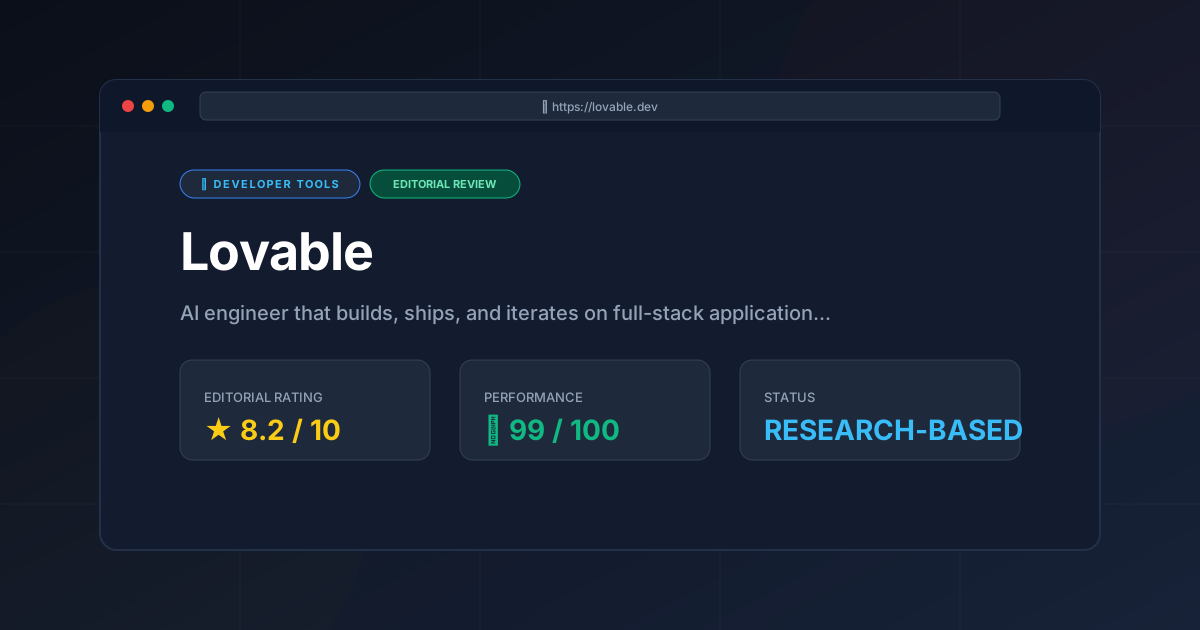
Editorial Rating: 8.2/10 #
Who should use Lovable?
- Startup Founders: To build and validate MVPs in days rather than months.
- Product Managers: To create high-fidelity functional prototypes for stakeholder approval.
- Frontend Developers: To skip the boilerplate phase and move straight to custom feature implementation.
- Indie Hackers: To ship small-to-medium SaaS tools with minimal overhead.
More Tools Worth Reading
Supabase
Developer ToolsOpen source firebase alternatives are evolving. Discover if Supabase is the right backend for your 2026 project with our deep technical analysis.
Supabase Edge Functions
Developer ToolsSupabase Edge Functions review: Explore the Deno-powered serverless architecture, pricing, and limitations to accelerate your global app deployment.
Supabase
Developer ToolsBackend-as-a-Service redefined. Explore our deep dive into Supabase 2026 to see if this open-source powerhouse is the right choice for your next proje...