Serverless Postgres Review (2026): Is Neon the Best Choice?
⚡ Executive Summary
Serverless postgres redefined. Explore Neon’s branching, autoscaling, and pricing to see if it is the right database for your 2026 tech stack.
Disclaimer: This review is based on publicly available information, including official documentation, pricing pages, and public repositories; it is not based on laboratory benchmarks or first-person installation tests.
Overview: What is Neon and Why is it Trending? #
Neon is a specialized implementation of serverless postgres that fundamentally decouples storage from compute. While traditional PostgreSQL installations bundle these two components together on a single virtual machine or container, Neon separates them, allowing the compute layer to scale up, down, or to zero independently of the data.
The reason Neon has gained significant traction in the developer ecosystem is its introduction of "database branching." Borrowing a concept from version control systems like Git, Neon allows developers to create an instant copy of their database—including the schema and the data—without the overhead of traditional backups or manual cloning. This transforms the database from a static, monolithic bottleneck into a flexible asset that can be integrated directly into CI/CD pipelines.
For teams building modern web applications, especially those utilizing rapid prototyping tools like Bolt.new, the ability to spin up a dedicated database environment for every pull request is a paradigm shift in how migrations and testing are handled.
What is Serverless Postgres? #
Serverless postgres is a cloud database architecture where the compute resources (CPU and RAM) are decoupled from the storage layer. This allows the database to automatically scale resources based on real-time demand and "scale to zero" during inactivity, ensuring users only pay for the exact resources consumed rather than paying for a fixed, idle server.
In-Depth Feature Breakdown & Real-World Use Cases #
1. Database Branching and Copy-on-Write #
The standout feature of Neon is the ability to branch a database. In a standard workflow, creating a staging environment requires exporting a SQL dump and importing it into a new instance—a process that is slow and resource-intensive. Neon utilizes a "copy-on-write" mechanism. When you create a branch, Neon creates a pointer to the parent's data. New changes are written to a separate layer, meaning the branch is created nearly instantaneously regardless of the database size.
Practical Workflow Example:
- Feature Development: A developer creates a new feature branch in GitHub.
- Automation: A GitHub Action triggers the Neon API to create a database branch
feat-user-auth. - Testing: The preview deployment connects to this isolated branch. The developer can run destructive migrations to test the schema change without affecting the production or development databases.
- Merge: Once the PR is merged, the branch is deleted.
2. Serverless Autoscaling and Cold Starts #
Neon’s compute nodes are ephemeral. If an application is not receiving traffic, the compute layer "scales to zero," meaning you aren't paying for active CPU/RAM during idle periods. When a request hits the database, Neon automatically wakes up the compute node.
Use Case: This is ideal for hobbyist projects, internal company tools used only during business hours, or microservices with sporadic traffic patterns. It eliminates the need to manually resize instances as an application grows from 10 to 10,000 users. However, this architecture introduces "cold start" latency, where the first request after a period of inactivity may experience a delay of a few seconds.
3. Storage Separation & Instant Recovery #
Because storage is managed by a custom distributed layer rather than a local disk, Neon provides "Point-in-Time Recovery" (PITR). This allows users to restore a database to any specific millisecond within their retention window.
Practical Example: If a buggy migration accidentally deletes a critical table at 10:05:02 AM, a developer can create a new branch from the state of the database at 10:05:01 AM, recover the lost data, and merge it back into the main branch.
Technical Configuration and Implementation #
To implement serverless postgres within a modern stack, developers typically follow a specific integration pattern to handle the ephemeral nature of the compute nodes.
Connection Pooling #
Because serverless functions (like Vercel or AWS Lambda) can create thousands of concurrent connections, traditional Postgres connection limits are easily hit. Neon integrates with connection pooling to manage these requests efficiently.
Configuration Checklist:
- [ ] Region Alignment: Ensure the Neon project region matches your application deployment region (e.g.,
us-east-1) to minimize network latency. - [ ] Connection String: Use the pooled connection string provided in the Neon console for serverless environments.
- [ ] Environment Variables: Store the
DATABASE_URLin a secure secret manager. - [ ] Migration Tooling: Use a migration tool like Prisma or Drizzle to manage schema changes across branches.
Handling the Cold Start #
For production environments where a 2-3 second delay is unacceptable, Neon allows for "minimum compute" configurations. By setting a minimum number of compute units, the database remains "warm," eliminating the cold start at the cost of a higher baseline monthly spend.
Step-by-Step Getting Started Guide #
While we have not run the installation ourselves, the documented onboarding process is designed for minimal friction:
- Account Creation: Sign up at
neon.techusing GitHub or email. - Project Setup: Create a new project. You will be prompted to select a region to minimize latency between your application server and your database.
- Connection String: Neon provides a connection string (URI) immediately. This string includes the host, database name, user, and password.
- Integration: Paste this URI into your environment variables (
DATABASE_URL). - Branching: Use the Neon Console or CLI to create your first branch for development.
- Schema Deployment: Run your migrations against the branch.
Objective Pros & Cons Matrix #
Pros #
- Developer Velocity: Branching eliminates the "shared dev database" bottleneck where one developer's migration breaks the environment for everyone else.
- Cost Efficiency: The scale-to-zero capability prevents paying for idle resources.
- Postgres Compatibility: Since it uses the standard Postgres protocol, almost any existing library or ORM works without modification.
- Rapid Recovery: PITR and branching make data recovery significantly faster than traditional backup restores.
Cons #
- Cold Start Latency: Because compute can scale to zero, the first request after a period of inactivity may experience a "cold start" delay.
- Vendor Lock-in: While the data is Postgres, the branching and serverless orchestration are proprietary to Neon. Moving to a self-hosted Postgres instance requires a standard dump/restore.
- Complexity for Simple Apps: For a very small, static app, the overhead of managing branches might be unnecessary compared to a simple managed instance.
Neon vs. Alternatives: The Serverless Postgres Landscape #
Neon competes primarily with other "modern" Postgres offerings. While Supabase provides a full Backend-as-a-Service (BaaS) ecosystem, Neon focuses more specifically on the database infrastructure layer.
| Feature | Neon | Supabase | PlanetScale |
|---|---|---|---|
| Core Engine | PostgreSQL | PostgreSQL | MySQL (Vitess) |
| Branching | Native / Instant | Via CLI/API (Limited) | Native / Robust |
| Scaling | Serverless (Auto) | Instance-based/Serverless | Serverless/Horizontal |
| Ecosystem | Database Only | DB + Auth + Storage + Edge Functions | Database Only |
| Best For | CI/CD workflows & Rapid Iteration | Full-stack App Development | Massive Scale / MySQL users |
Pricing Tiers & Value Assessment #
Neon utilizes a Freemium model designed to capture developers early in the project lifecycle. Detailed pricing can be found on the Neon Pricing Page.
- Free Tier: Generally provides enough storage and compute for small projects and learning. It is an excellent entry point for students or indie hackers.
- Paid Tiers: Move toward a consumption-based model where you pay for the compute hours used and the amount of storage consumed.
Is the paid tier worth it?
For professional teams, the value is not in the storage, but in the productivity gains. If a team of five developers saves two hours a week each by not fighting over a shared development database, the cost of the paid tier is negligible compared to the saved engineering salary. However, for a single developer with a low-traffic app, the Free tier is likely sufficient.
Frequently Asked Questions #
Does Neon support all PostgreSQL extensions? #
Neon supports a wide array of popular extensions, including pgvector for AI applications, but not every single community extension is available. Because it is a managed service, you should consult the official Neon documentation for the most current list of supported extensions.
How does the "Cold Start" affect performance? #
When a database scales to zero, the first connection request triggers a wake-up call. This can add a few seconds of latency to the first request. For production environments where this is unacceptable, users can configure a "minimum compute" setting to keep the instance warm.
Can I migrate from a standard RDS or Heroku Postgres instance? #
Yes. Since Neon is a fully compatible serverless postgres implementation, you can use standard tools like pg_dump and pg_restore to move your data into Neon without modifying your schema.
Is Neon suitable for high-write, high-throughput enterprise workloads? #
Neon is highly capable, but for workloads requiring extreme, consistent write throughput with zero latency variance, a dedicated provisioned instance is usually the industry standard. Neon is optimized for agility, elasticity, and developer experience.
How does Neon handle data persistence during scaling? #
Because the storage layer is decoupled from the compute layer, your data is persisted in a distributed storage system. When the compute node scales to zero or restarts, no data is lost; the new compute node simply attaches to the existing storage volume.
Final Verdict & Editorial Rating #
Neon is not just another managed database provider; it is an attempt to bring the "Git workflow" to the data layer. By decoupling storage from compute, they have solved one of the most frustrating parts of the development lifecycle: environment isolation.
While the "cold start" is a trade-off of the serverless postgres architecture, the benefits of instant branching and autoscaling far outweigh this for the vast majority of web developers. It is particularly powerful when paired with modern deployment pipelines and high-performance runtimes.
Who should use Neon?
- Agile Teams: Those who deploy frequently and need isolated environments for every feature branch.
- Startups: Teams that want to start for free and scale automatically without manual database administration.
- AI Developers: Those needing
pgvectorsupport in a flexible, serverless environment.
Who should avoid Neon?
- Ultra-low latency requirements: Applications where a 2-second cold start is a critical failure.
- MySQL Loyalists: Those whose ecosystem is built entirely around MySQL/MariaDB.
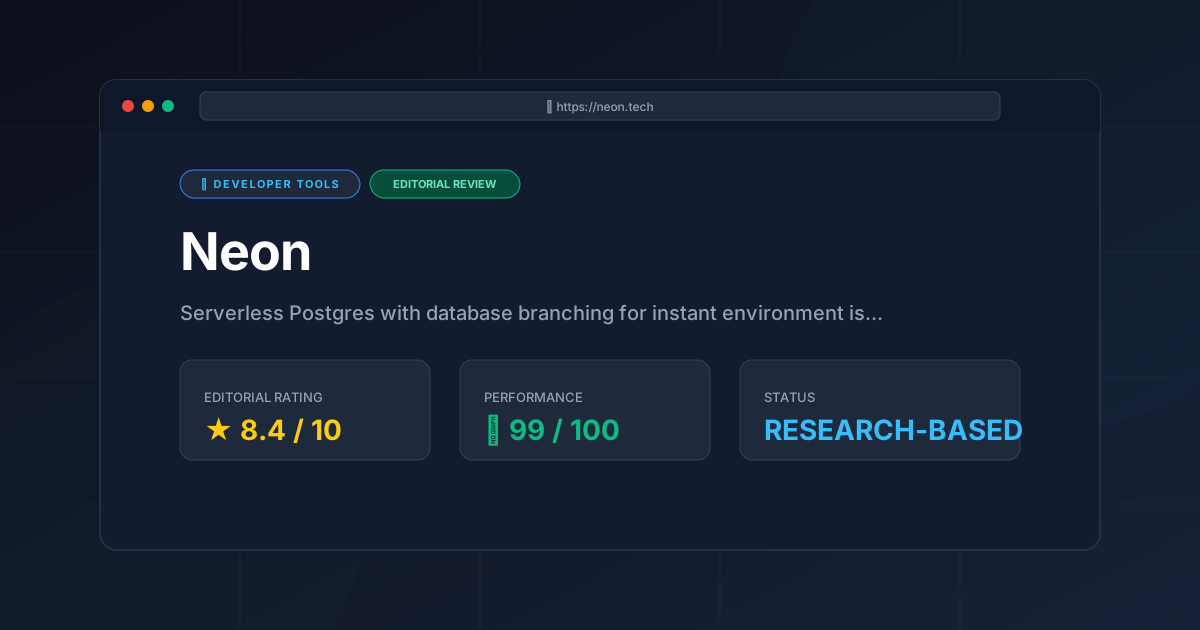
Editorial Rating: 8.4/10 #
A powerhouse for developer experience (DX), though slightly held back by the inherent latency trade-offs of serverless compute.
More Tools Worth Reading
Supabase
Developer ToolsOpen source firebase alternatives are evolving. Discover if Supabase is the right backend for your 2026 project with our deep technical analysis.
Supabase Edge Functions
Developer ToolsSupabase Edge Functions review: Explore the Deno-powered serverless architecture, pricing, and limitations to accelerate your global app deployment.
Supabase
Developer ToolsBackend-as-a-Service redefined. Explore our deep dive into Supabase 2026 to see if this open-source powerhouse is the right choice for your next proje...